DEF 14A: Definitive proxy statements
Published on March 31, 2026
Table of Contents
☐ |
Preliminary Proxy Statement |
☐ |
Confidential, for Use of the Commission Only (as permitted by Rule 14a-6(e)(2)) |
☒ |
Definitive Proxy Statement |
☐ |
Definitive Additional Materials |
☐ |
Soliciting Material under § 240.14a-12 |
☒ |
No fee required |
☐ |
Fee paid previously with preliminary materials |
☐ |
Fee computed on table in exhibit required by Item 25(b) per Exchange Act Rules 14a-6(i)(1) and 0-11 |
Table of Contents

2026
Notice of Annual Meeting of Stockholders
and Proxy Statement
Table of Contents
| CORE SCIENTIFIC 2026 PROXY STATEMENT Letter to Stockholders |
LETTER TO STOCKHOLDERS
During 2025, Core Scientific made meaningful progress in its transition toward high-density colocation infrastructure. The year was defined by execution: taking a large, contracted opportunity, expanding it, and translating it into physical development across multiple sites.
Early in 2025, we expanded our agreement with CoreWeave by an additional 70 megawatts, bringing total contracted capacity to approximately 590 megawatts across five data center sites and increasing projected revenue over the 12-year term to more than $10 billion. This agreement gives us scale, visibility, and a long-term framework for growth.
With this contracted capacity in place, a major focus in 2025 was execution and the delivery of the power and infrastructure required to support large-scale artificial intelligence and high-performance computing deployments by advancing projects in: Denton, Texas; Marble, North Carolina; Muskogee, Oklahoma; and Dalton, Georgia. This included solving for power, construction sequencing, equipment delivery, and operational coordination at a level of complexity that few companies have managed at comparable speed.
The scale of that effort was substantial. Across four locations, we advanced development of more than 1 million square feet of data center shell, installed nearly $2 billion of infrastructure assets, and supported more than 5 million labor hours, with an average of approximately 3,300 workers on site. In total, these buildouts represent more than $5 billion of infrastructure investment, the substantial majority of which is expected to be funded by our customer.
These figures are important because they reflect tangible progress towards building out the next generation of AI infrastructure. As of the date of this Proxy Statement, we had energized approximately 350 megawatts across these sites, with more than 180 megawatts online and billing. The work of building is now beginning to show up in the economics of the business.
2025 unfolded against a market backdrop, where at times, there were questions on the durability of AI demand. Our view remains that this industry is still in its early innings. The more important question for us is not whether demand would fluctuate quarter to quarter, but whether we are building the right assets in the right locations with the discipline required to serve long-duration customer needs.
The year also strengthened our position beyond existing contracts. As we advanced contracted capacity, we also continued to create a broader runway for growth: delivery of 2026 capacity tied to existing commitments, development pathways across multiple locations that are not yet under contract, and a larger opportunity set for future customers seeking ready, scalable infrastructure. Value in this sector comes not only from current deployments, but from controlling sites, ordering long-lead equipment, and moving projects through early pre-construction work before demand fully crystallizes.
That is how we are deploying capital: with a practical focus on projects we believe offer the most attractive long-term returns, including site acquisitions, long-lead equipment orders, and early-stage development work that can accelerate future delivery.
We believe 2026 will mark an important inflection point for Core Scientific. 2025 was the year of building and energizing capacity, and we believe 2026 will be the year in which that effort becomes increasingly visible in revenue, operating profile, and new customer opportunities. We are entering the year with stronger infrastructure, deeper execution experience, and a broader strategic footing than we had a year ago.
Thank you for your continued support.
Adam Sullivan
President and Chief Executive Officer

Table of Contents
| CORE SCIENTIFIC 2026 PROXY STATEMENT Notice of Annual Meeting |
NOTICE OF ANNUAL MEETING OF
STOCKHOLDERS

|

| |
| Date and Time: Tuesday, May 12, 2026 10:00 a.m. Eastern Time |
Meeting Place: At www.virtualshareholdermeeting.com/CORZ2026 |
Dear Fellow Stockholder,
It is my pleasure to invite you to attend the Annual Meeting of Stockholders (the “Annual Meeting”) of Core Scientific, Inc., a Delaware corporation (the “Company”). The Annual Meeting will be held virtually via live webcast available at www.virtualshareholdermeeting.com/CORZ2026, on Tuesday, May 12, 2026 at 10:00 a.m. Eastern Time. Stockholders attending the Annual Meeting virtually will be afforded the same rights and opportunities to participate as they would at an in-person meeting. We encourage you to attend online and participate. We recommend that you log in 15 minutes before 10:00 a.m Eastern Time on May 12, 2026 to ensure you are logged in when the Annual Meeting starts.
The Annual Meeting will be held for the following purposes:
| 1. | To elect the Board of Directors’ five nominees for director identified in the attached proxy statement to hold office until the 2027 Annual Meeting of Stockholders. |
| 2. | To approve, on a non-binding, advisory basis, the compensation of our named executive officers, as disclosed in this proxy statement. |
| 3. | To ratify the selection of KPMG LLP as our independent registered public accounting firm for the fiscal year ending December 31, 2026. |
The record date (the “Record Date”) for the Annual Meeting is March 23, 2026. Only stockholders of record at the close of business on the Record Date are entitled to notice of, and to vote at, the Annual Meeting.

Todd M. DuChene
Chief Legal and Administrative Officer and Secretary
Dover, Delaware
March 31, 2026
| Your vote is important! Please vote. Important Notice Regarding the Availability of Proxy Materials for the Stockholder Meeting to Be Held on May 12, 2026. The Notice of Annual Meeting, Proxy Statement and Annual Report on Form 10-K are available at h.t.t.p.s://investors.corescientific.com and www.virtualshareholdermeeting.com/CORZ2026 It is important that proxies be completed and submitted promptly. Therefore, whether or not you plan to be present at
|
||||
Table of Contents
| CORE SCIENTIFIC 2026 PROXY STATEMENT Table of Contents |
| i |
TABLE OF CONTENTS
Table of Contents
| CORE SCIENTIFIC 2026 PROXY STATEMENT Proxy Statement for the 2026 Annual Meeting of Stockholders |
| 1 |
CORE SCIENTIFIC, INC.
838 Walker Road
Suite 21-2105
Dover, Delaware 19904
PROXY STATEMENT FOR THE 2026 ANNUAL MEETING OF STOCKHOLDERS
May 12, 2026
Questions and answers about these proxy materials and voting
Why did I receive a notice regarding the availability of proxy materials on the Internet?
Pursuant to rules adopted by the Securities and Exchange Commission (the “SEC”), we have elected to provide access to our proxy materials over the internet. Accordingly, we have sent you a Notice of Internet Availability of Proxy Materials (the “Notice”) because the board of directors (the “Board of Directors” or “Board”) of Core Scientific, Inc. (sometimes referred to as “the Company,” “Core,” “we” and “our”) is soliciting, on the Company’s behalf, your proxy to vote at the 2026 Annual Meeting of Stockholders (the “Annual Meeting”), including at any adjournments or postponements of the meeting. All stockholders will have the ability to access the proxy materials on the website referred to in the Notice or request to receive a printed set of the proxy materials. Instructions on how to access the proxy materials over the internet or to request a printed copy may be found in the Notice.
We intend to first mail the Notice and make this proxy statement (the “Proxy Statement”) and the form of proxy available to stockholders on or about March 31, 2026.
How do I attend the Annual Meeting?
We will be hosting the Annual Meeting via live audio webcast only. Stockholders will not be able to physically attend the Annual Meeting. You are entitled to attend the Annual Meeting if you were a stockholder of record as of the close of business on March 23, 2026 (the “Record Date”), or hold a valid proxy for the meeting. You can attend the annual meeting by visiting www.virtualshareholdermeeting.com/CORZ2026, where you will be able to listen to the Annual Meeting live, submit questions and vote online.
The meeting will be held on Tuesday, May 12, 2026 at 10:00 a.m. Eastern Time. We encourage you to access the Annual Meeting 15 minutes prior to the start time to allow time for online check-in. We have worked to offer the same participation opportunities as would be provided at an in-person meeting while further enhancing the online experience available to all stockholders regardless of their location. However, please be aware that you must bear any costs associated with your internet access, such as usage charges from internet access providers and telephone companies.
In order to enter the Annual Meeting virtually, you will need the unique 16-digit control number, which is included on your Notice or proxy card if you are a common stockholder of record or included with your voting instruction card and voting instructions received from your broker, bank, trustee, or nominee if you are the beneficial owner of the shares held in “street name.”
Can I ask questions at the Annual Meeting?
Stockholders will have the ability to submit questions during the Annual Meeting via the Annual Meeting website at www.virtualshareholdermeeting.com/CORZ2026. Questions may be submitted online shortly prior to, and during, the Annual Meeting by logging in with the 16-digit control number at www.virtualshareholdermeeting.com/CORZ2026. Additional information regarding the rules and procedures for participating in the virtual Annual Meeting will be provided in our rules of conduct for the Annual Meeting, which stockholders can view during the meeting at www.virtualshareholdermeeting.com/CORZ2026.
What if I have technical difficulties or trouble accessing the virtual meeting website?
Technicians will be available to assist you with any technical difficulties you may have accessing the virtual meeting website. If you encounter any difficulties accessing the virtual meeting website during the online check-in or meeting time, please call the technical support number that will be posted on the Annual Meeting log in page.
Table of Contents
| 2 | | CORE SCIENTIFIC 2026 PROXY STATEMENT Proxy Statement for the 2026 Annual Meeting of Stockholders |
What if I cannot virtually attend the Annual Meeting?
You may vote your shares electronically before the meeting by internet, by proxy or by telephone as described below. You do not need to access the Annual Meeting audio-only webcast to vote if you submitted your vote via proxy, by internet or by telephone in advance of the Annual Meeting.
Who can vote at the Annual Meeting?
Only common stockholders of record at the close of business on the Record Date will be entitled to vote at the Annual Meeting. On the Record Date, there were 315,594,802 shares of common stock outstanding and entitled to vote. A list of stockholders entitled to vote at the Annual Meeting will be available at our principal executive offices for examination during ordinary business hours by any stockholder for any purpose germane to the Annual Meeting for a period of ten days prior to the Annual Meeting through the close of the Annual Meeting.
Stockholder of Record: Shares Registered in Your Name
If on the Record Date, your shares of common stock were registered directly in your name with our transfer agent, Computershare Trust Company, N.A., then you are a stockholder of record. As a stockholder of record, you may vote at the Annual Meeting virtually or vote by proxy prior to the Annual Meeting. Whether or not you plan to attend the Annual Meeting, we urge you to fill out and return your vote by proxy through the Internet or over the telephone or vote by proxy using a proxy card.
Beneficial Owner: Shares Registered in the Name of a Broker or Bank
If on the Record Date, your shares were held not in your name but rather in an account at a brokerage firm, bank, or other similar organization, then you are the beneficial owner of shares held in “street name” and the Notice should be forwarded to you by that organization. The organization holding your account is considered to be the stockholder of record for purposes of voting at the Annual Meeting. As a beneficial owner, you have the right to direct your broker, bank, or other agent regarding how to vote the shares in your account. You are also invited to attend the Annual Meeting. However, since you are not the stockholder of record you may not vote your shares at the Annual Meeting even if you participate virtually unless you request and obtain a valid proxy from your broker, bank, or other agent.
How many votes do I have?
Each holder of our common stock will have one vote per share of common stock held as of the Record Date.
What am I voting on?
There are three matters scheduled for a vote:
| • | The election of the Board of Directors’ five nominees for director named in this Proxy Statement, each to hold office until the 2027 Annual Meeting of Stockholders (Proposal 1); |
| • | Approval, on a non-binding, advisory basis, of the compensation of our named executive officers, as disclosed in this Proxy Statement (Proposal 2); and |
| • | Ratification of the selection of KPMG LLP as our independent registered public accounting firm for the fiscal year ending December 31, 2026 (Proposal 3). |
What if another matter is properly brought before the Annual Meeting?
The Board of Directors knows of no other matters that will be presented for consideration at the Annual Meeting. If any other matters are properly brought before the Annual Meeting, it is the intention of the persons named in the accompanying proxy to vote on those matters in accordance with their best judgment.
What does it mean if I receive more than one set of proxy materials?
If you receive more than one set of proxy materials, your shares may be registered in more than one name or in different accounts. To vote all of your shares by proxy, you must complete, date, sign and return each proxy card and voting instruction form that you receive or vote over the telephone or via the internet the shares represented by each e-mail, proxy card or voting instruction form that you receive. Please follow the voting instructions on the Notices to ensure that all of your shares are voted.
Table of Contents
| CORE SCIENTIFIC 2026 PROXY STATEMENT Proxy Statement for the 2026 Annual Meeting of Stockholders |
| 3 |
How do I vote?
The procedures for voting are as follows:
Stockholder of Record: Shares Registered in Your Name
If you are a stockholder of record, you may vote at the Annual Meeting or you may vote by proxy through the Internet, over the telephone or using a proxy card. Whether or not you plan to attend the Annual Meeting, we urge you to vote by proxy to ensure your vote is counted. You may still attend the Annual Meeting and vote electronically even if you have already voted by proxy.
| • | To vote online at the Annual Meeting, you will need to visit www.virtualshareholdermeeting.com/CORZ2026 during the Annual Meeting while the polls are open and follow the instructions provided. You will be asked to provide the 16-digit control number from the Notice or proxy card and follow the instructions. |
| • | To vote in advance of the Annual Meeting through the Internet, go to www.virtualshareholdermeeting.com/CORZ2026 to complete an electronic proxy card. You will be asked to provide the 16-digit control number from the Notice or proxy card. Your Internet vote must be received by 11:59 p.m., Eastern Time, on May 11, 2026 to be counted. |
| • | To vote in advance of the Annual Meeting over the telephone, dial toll-free 1-800-690-6903 using a touch-tone phone and follow the recorded instructions. You will be asked to provide the 16-digit control number from the proxy card. Your telephone vote must be received by 11:59 p.m., Eastern Time, on May 11, 2026 to be counted. |
| • | To vote in advance of the Annual Meeting using a printed proxy card that may be delivered to you, simply complete, sign and date the proxy card and return it promptly in the envelope provided. If you return your signed proxy card to us before the Annual Meeting, we will vote your shares as you direct. |
Beneficial Owner: Shares Registered in the Name of Broker or Bank
If you are a beneficial owner of shares registered in the name of your broker, bank, or other agent, you should have received a copy of the Notice containing voting instructions from that organization rather than from us. You must follow these instructions for your bank, broker, or other stockholder of record to vote your shares per your instructions. Alternatively, you may vote by telephone or over the internet as instructed by your broker or bank.
| We provide Internet proxy voting to allow you to vote your shares online, with procedures designed to ensure the authenticity and correctness of your proxy vote instructions. However, please be aware that you must bear any costs associated with your Internet access, such as usage charges from internet access providers and telephone companies.
|
||||
If I am a stockholder of record and I do not vote, or if I return a proxy card or otherwise vote without giving specific voting instructions, what happens?
If you are a stockholder of record and do not vote by completing the proxy card that may be delivered to you, by telephone, through the Internet or electronically at the Annual Meeting, your shares will not be voted.
If you return a signed and dated proxy card or otherwise vote without marking voting selections, your shares will be voted in accordance with the recommendations of the Board of Directors:
| • | “FOR” the election of each of the five nominees for director named in this Proxy Statement (Proposal 1). If any nominee becomes unavailable for election as a result of an unexpected occurrence, shares that would have been voted for such nominee will instead be voted for the election of a substitute nominee proposed by us; |
| • | “FOR” the non-binding, advisory approval of executive compensation (Proposal 2); and |
| • | “FOR” the selection of KPMG LLP as our independent registered public accounting firm for the fiscal year ending December 31, 2026 (Proposal 3). |
If any other matter is properly presented at the Annual Meeting, your proxyholder (one of the individuals named on your proxy card) will vote your shares using his or her best judgment.
Table of Contents
| 4 | | CORE SCIENTIFIC 2026 PROXY STATEMENT Proxy Statement for the 2026 Annual Meeting of Stockholders |
If I am a beneficial owner of shares held in street name and I do not provide my broker or bank with voting instructions, what happens?
If you are a beneficial owner of shares held in street name and you do not instruct your broker, bank, or other agent how to vote your shares, your broker, bank, or other agent may still be able to vote your shares in its discretion. Brokers, banks, and other securities intermediaries may use their discretion to vote your “uninstructed” shares with respect to matters considered to be “routine,” but not with respect to “non-routine” matters. In this regard, Proposals 1 and 2 are considered to be “non-routine,” meaning that your broker may not vote your shares on this proposal in the absence of your voting instructions. However, Proposal 3 is considered to be a “routine” matter, meaning that if you do not return voting instructions to your broker by its deadline, your shares may be voted by your broker in its discretion on Proposal 3. Accordingly, if you own shares through a nominee, such as a broker, bank, or other agent, please be sure to instruct your nominee how to vote to ensure that your vote is counted on all of the proposals.
If you are a beneficial owner of shares held in street name, in order to ensure your shares are voted in the way you would prefer, you must provide voting instructions to your broker, bank or other agent by the deadline provided in the materials you receive from your broker, bank or other agent.
What are “broker non-votes”?
As discussed above, when a beneficial owner of shares held in “street name” does not give instructions to the broker or nominee holding the shares as to how to vote on matters deemed to be “non-routine,” the broker or nominee cannot vote the shares. These unvoted shares are counted as “broker non-votes.” Proposals 1 and 2 are considered to be “non-routine,” and we therefore expect broker non-votes to exist in connection with these proposals.
As a reminder, if you are a beneficial owner of shares held in street name, in order to ensure your shares are voted in the way you would prefer, you must provide voting instructions to your broker, bank or other agent by the deadline provided in the materials you receive from your broker, bank or other agent.
Can I change my vote after submitting my proxy?
Stockholder of Record: Shares Registered in Your Name
Yes. You can revoke your proxy at any time before the final vote at the Annual Meeting. If you are the record holder of your shares, you may revoke your proxy in any one of the following ways:
| • | You may grant a subsequent proxy by telephone or through the Internet. |
| • | You may send a timely written notice that you are revoking your proxy to our Corporate Secretary at 838 Walker Road, Suite 21-2105, Dover, Delaware 19904. |
| • | You may attend the Annual Meeting virtually and vote online. Simply attending the Annual Meeting virtually will not, by itself, revoke your proxy. Even if you plan to attend the Annual Meeting virtually, we recommend that you also submit your proxy or voting instructions or vote by telephone or through the Internet so that your vote will be counted if you later decide not to attend the Annual Meeting. |
Your most current proxy card or telephone or Internet proxy is the one that is counted.
Beneficial Owner: Shares Registered in the Name of Broker or Bank
If your shares are held by your broker, bank, or other agent, you should follow the instructions provided by your broker, bank, or other agent.
How are votes counted?
Votes will be counted by the inspector of election appointed for the Annual Meeting, who will separately count, (i) with respect to Proposal 1, votes “FOR,” “WITHHOLD” and broker non-votes; and (ii) with respect to Proposals 2 and 3, votes “FOR,” “AGAINST,” abstentions and broker non-votes (although no broker non-votes are expected on Proposal 3).
Table of Contents
| CORE SCIENTIFIC 2026 PROXY STATEMENT Proxy Statement for the 2026 Annual Meeting of Stockholders |
| 5 |
What vote is required for adoption or approval of each proposal and how will votes be counted?
| Proposal |
Vote Required for Approval | Effect of Abstentions or Withhold Votes, As Applicable |
Effect of Broker Non-Votes |
Board of Directors Recommendation | ||||
| 1. Election of Director |
Directors are elected by a plurality of the shares present in person or represented by proxy at the Annual Meeting and entitled to vote. In other words, the five nominees receiving the most “FOR” votes will be elected. | No Effect | No Effect | “FOR” its nominee | ||||
| 2. Advisory approval of the compensation of the Company’s Named |
The affirmative vote of the holders of a majority of the votes cast on the proposal. A majority of the votes cast means that the number of votes cast “FOR” the proposal must exceed the number of votes cast “AGAINST” the proposal for the proposal to be approved. Because this proposal is an advisory vote, the result will not be binding on our Board of Directors. | No Effect | No Effect | “FOR” | ||||
| 3. Ratification of the appointment of KPMG LLP as the Company’s independent registered public accounting firm for the fiscal year ending December 31, 2026 |
The affirmative vote of the holders of a majority of the votes cast on the proposal. A majority of the votes cast means that the number of votes cast “FOR” the proposal must exceed the number of votes cast “AGAINST” the proposal for the proposal to be approved. | No Effect | Not applicable | “FOR” |
What is the quorum requirement?
A quorum of stockholders is necessary to hold a valid meeting. A quorum will be present if stockholders holding at least a majority of the voting power of the outstanding shares entitled to vote at the Annual Meeting are present at the Annual Meeting in person, by remote communication, if applicable, or represented by proxy. On the Record Date, there were 315,594,802 shares outstanding and entitled to vote at the Annual Meeting.
Your shares will be counted towards the quorum only if you submit a valid proxy (or one is submitted on your behalf by your broker, bank, or other nominee) or if you vote electronically at the Annual Meeting. Abstentions and broker non-votes will be counted towards the quorum requirement. If there is no quorum, either the chairperson of the Annual Meeting or the holders of a majority of voting power of the shares present at the Annual Meeting in person, by remote communication, or represented by proxy and entitled to vote thereon, may adjourn the Annual Meeting to another date.
Who is paying for this proxy solicitation?
We will pay for the entire cost of soliciting proxies. In addition to the proxy materials, our directors and employees may also solicit proxies in person, by telephone, or by other means of communication. Directors and employees will not be paid any additional compensation for soliciting proxies. We may also reimburse brokerage firms, banks, and other agents for the cost of forwarding proxy materials to beneficial owners. We expect to pay MacKenzie Partners, Inc., a fee of $14,500 plus reasonable expenses for these services.
Table of Contents
| 6 | | CORE SCIENTIFIC 2026 PROXY STATEMENT Proxy Statement for the 2026 Annual Meeting of Stockholders |
How can I find out the results of the voting at the Annual Meeting?
Preliminary voting results will be announced at the Annual Meeting. In addition, final voting results will be published in a current report on Form 8-K that we expect to file within four business days after the Annual Meeting. If final voting results are not available to us in time to file a Form 8-K within four business days after the Annual Meeting, we intend to file a Form 8-K to publish preliminary results and, within four business days after the final results are known to us, file an additional Form 8-K to publish the final results.
Table of Contents
| CORE SCIENTIFIC 2026 PROXY STATEMENT Proposal 1: Election of Directors |
| 7 |
PROPOSAL 1
ELECTION OF DIRECTORS
General
Our Board of Directors currently consists of six directors. Jordan Levy, the Chairman of the Board, will not stand for re-election to the Board at the Annual Meeting. Effective upon the expiration of Mr. Levy’s term at the Annual Meeting and immediately prior to the election of directors at the Annual Meeting, the Board of Directors has determined to reduce the size of the Board to five members.
Based upon the recommendation of the Nominating and Corporate Governance Committee, the Board of Directors has considered and nominated each of the following individuals for election to the Board at the Annual Meeting:
| • | Jeff Booth |
| • | Elizabeth Crain |
| • | Yadin Rozov |
| • | Adam Sullivan |
| • | Eric Weiss |
Each of the nominees is currently a member of our board of directors. Each of Mr. Booth, Mr. Rozov and Mr. Weiss was appointed to our Board of Directors on January 23, 2024, pursuant to the Company’s plan of reorganization under the jointly administered Chapter 11 cases under the caption “CORE SCIENTIFIC, INC. et al Debtors” and set forth in the Fourth Amended Joint Chapter 11 Plan of Core Scientific and its affiliated debtors, dated January 15, 2024. Ms. Crain was appointed to our Board of Directors on May 14, 2025 to fill the vacancy on the Board created by the resignation of Todd Becker. Mr. Sullivan was previously elected to the Board by our stockholders at our 2025 annual meeting of stockholders.
Each director elected at the Annual Meeting will hold office until the 2027 annual meeting of stockholders, or in each case until their respective successors are duly elected and qualified, or until their earlier death, resignation, or removal.
Pursuant to the Company’s Third Amended and Restated Bylaws, vacancies on the Board of Directors may be filled by persons elected by a majority of the remaining directors. A director elected by our Board of Directors to fill a vacancy, including vacancies created by an increase in the number of directors, shall serve for the remainder of the full term and until the director’s successor is duly elected and qualified or until such director’s earlier death, resignation, or removal.
In February 2026, we entered into a Cooperation Agreement (the “Cooperation Agreement”) with Two Seas Capital LLC (“Two Seas”), pursuant to which we agreed to: (i) appoint one independent director following the execution of the Cooperation Agreement and prior to March 15, 2026, (ii) appoint a second independent director as soon a reasonably practicable following the Annual Meeting, but in no event later than September 15, 2026, and (iii) appoint a third independent director prior to the 2027 annual meeting of stockholders, in each case, in consultation with Two Seas. Until the 2027 annual meeting of stockholders, we agreed to not increase the size of the Board of Directors in excess of nine directors or decrease the size of the Board of Directors if such decrease would require resignation of one of the new directors, in each case without the prior consent of Two Seas. In March 2026, we and Two Seas agreed to delay the appointment of the initial independent director until after the Annual Meeting in order to provide more time to identify a suitable candidate.
We have no reason to believe that any of the nominees will be unavailable or, if elected, will decline to serve. In the event that any of these nominees should become unavailable for election due to any presently unforeseen reason or should for good cause decline to serve, proxies will be voted for a substitute as designated by the Board of Directors, or alternatively, the Board of Directors may leave a vacancy on the Board or reduce the size of the Board.
| Recommendation of the Board of Directors |
||||||||
| The Board of Directors recommends voting “FOR” each director nominee named above.
|
||||||||
Table of Contents
| 8 | | CORE SCIENTIFIC 2026 PROXY STATEMENT Information Regarding Director Nominees |
INFORMATION REGARDING DIRECTOR NOMINEES
The following is a brief biography of our nominees for director and a discussion of the specific experience, qualifications, attributes, or skills of the nominees that led us to conclude that such persons should serve as directors. We believe that, as a whole, the Board of Directors possesses the requisite skills and characteristics, leadership traits, work ethic, and independence to provide effective oversight.
No director nominee is related by blood, marriage, or adoption to any other director nominee or executive officer. No arrangements or understandings exist between any director nominee and any other person pursuant to which such person was selected as a nominee. Further, there are no legal proceedings to which any director nominee or continuing director is a party adverse to us or any of our subsidiaries or in which any such person has a material interest adverse to us or any of our subsidiaries.
Information Regarding Director Nominees
| Mr. Sullivan has served on our Board of Directors since January 23, 2024. Mr. Sullivan has served as our President since May 15, 2023 and as our Chief Executive Officer since August 2, 2023. Prior to joining the Company, from 2017 to 2023, Mr. Sullivan served as Managing Director and Head of the Digital Assets and Infrastructure Group at XMS Capital Partners (a financial advisory firm) where he oversaw over $5 billion of transactions. While employed at XMS Capital Partners, Mr. Sullivan represented Power and Digital Infrastructure Acquisition Corporation in its acquisition of Core Scientific Holding Co., a predecessor, and its subsidiary entities (collectively, “Legacy Core”) in 2021. He received his B.A. in Financial Economics from the University of Rochester.
We believe that Mr. Sullivan’s expertise with respect to the bitcoin mining and digital data center industries and the operation of our business provide him with the qualifications and skills to serve on our Board of Directors. | ||||||
| Adam Sullivan President and CEO
Age: 34
Director Since: 2024
Committees: N/A
|
||||||
| Mr. Booth has served on our Board of Directors since January 23, 2024. Mr. Booth is currently an entrepreneur and author of “The Price of Tomorrow – Why Deflation is Key to an Abundant Future.” From 1999 to 2017, Mr. Booth was Chief Executive Officer and Founder of BuildDirect.com Technologies, Inc. (TSX-V: BILD) a company that connects buyers and sellers of building materials and equipment to simplify the home improvement market. Mr. Booth is a Founding Partner of ego death capital, a venture capital fund that invest in entrepreneurs solving world problems. Mr. Booth’s insights and achievements have earned him the BC Technology Industry Association’s Person of the Year in 2015, and in October 2023, he was honored with induction into BCTIA’s Hall of Fame. Furthermore, in 2016, he gained recognition from Goldman Sachs, who named him one of the 100 Most Intriguing Entrepreneurs. He is a co-founder of Addy and NocNoc. Mr. Booth also actively serves on the Board of Directors of Fedi, and Breez, in addition to several advisory boards. A dedicated member of the Young Presidents Organization since 2004, he further contributes as a Founding Fellow at the Creative Destruction Lab.
We believe Mr. Booth’s entrepreneurial efforts, experience in bitcoin and other technology driven enterprises provide him with the qualifications and skills to serve on our Board of Directors. | ||||||
| Jeff Booth Independent Director
Age: 56
Director Since: 2024
Committees: Audit Compensation Nominating and Corporate Governance
|
||||||
Table of Contents
| CORE SCIENTIFIC 2026 PROXY STATEMENT Information Regarding Director Nominees |
| 9 |
| Ms. Crain has served on our Board of Directors since May 14, 2025. Ms. Crain was Chief Operating Officer and a Co-Founder of Moelis & Company (“Moelis”), an investment banking firm, from its inception in 2007 through 2023. She led Moelis’ global strategy, operations, and risk functions through all stages of the firm’s growth. Prior to Moelis, Ms. Crain was a Managing Director at UBS Investment Bank from 2001 to 2007, where she served as the Chief Operating Officer of the UBS Investment Banking Department Americas and was a member of the Investment Bank Board. From 1997 to 2001, Ms. Crain was in the private equity industry, after beginning her career in 1988 at Merrill Lynch. Ms. Crain is a member of the Board of Nokia Corporation (NYSE: NOK) and Chair of the Strategy Committee and member of the Personnel Committee. In addition, she is an Advisory Partner at Consello Group, a global advisory firm that works with companies on strategy and value creation since 2024. Ms. Crain holds an MBA from The Wharton School, University of Pennsylvania, and a B.S. in Economics from Arizona State University.
We believe Ms. Crain is well suited to serve as a director on our Board of Directors due to her experience in strategic planning and execution, operational leadership, and corporate governance. | ||||||
| Elizabeth Crain Independent Director
Age: 61
Director Since: 2025
Committees: Audit (Chair)
|
||||||
| Mr. Rozov has served on our Board of Directors since January 23, 2024. Since September 2025, Mr. Rozov has served as Chief Executive Officer of Ambac Assurance Corporation and Chief Investment Officer of American Acorn Corporation. Mr. Rozov is also the founder and managing partner of Terrace Edge Ventures LLC. From 2019 to 2021, he was a Partner of GoldenTree Asset Management LLC and also served as Chief Executive Officer and President of Syncora Guarantee Inc. and, from 2020 to 2021, as Chief Executive Officer of Financial Guaranty UK Ltd. From 2009 to 2019, he was a Partner and Managing Director at Moelis & Company, where he headed the Financial Institutions Advisory group and served on the Management Committee of Moelis Asset Management. From 2014 to 2019, he helped co-found College Avenue Student Loans LLC, where he served on the board, and co-founded Chamonix Partners Capital Management LLC. From 2007 to 2009, he was a Managing Director at UBS AG, where he served as Head of the Americas for the Repositioning Group. Mr. Rozov currently serves on the boards of Dave Inc. and Oramed Pharmaceuticals Inc. and previously served on the boards of Midwest Holding Inc. and Neo Performance Materials Inc. He holds an M.Sc. in data science from Columbia University and a bachelor’s degree with highest honors in physics and materials engineering from Rutgers University.
We believe Mr. Rozov is well suited to serve as a director on our Board of Directors due to his extensive experience in the financial services industry, both as an executive and a founder. | ||||||
| Yadin Rozov Independent Director
Age: 48
Director Since: 2024
Committees: Audit Compensation (Chair)
|
||||||
Table of Contents
| 10 | | CORE SCIENTIFIC 2026 PROXY STATEMENT Information Regarding Director Nominees |
| Mr. Weiss has served on our Board of Directors since January 23, 2024. Mr. Weiss is the founder and Chief Investment Officer for Blockchain Investment Group LP, a hedge fund of funds investing exclusively in blockchain assets since October 2017. Mr. Weiss began his career as a US Government bond trader at Morgan Stanley Dean Witter. After earning his MBA from Columbia Business School, Mr. Weiss joined the Private Equity and Venture Capital Division of GE Capital as a Director in the internet business space. While in this role, Mr. Weiss joined a client company, Internet Capital Group (ICG), as a Director of investments in business-to-business internet companies. Mr. Weiss also served as ICG’s Board of Directors representative for a number of portfolio companies. After ICG, Mr. Weiss served as a founding Principal at Stripes, identifying and leading investments in the online direct marketing space. Mr. Weiss has also been an active investor of personal capital in hedge funds and hedge fund of funds for over twenty years and purchased his first bitcoin in December 2013. Mr. Weiss is a director of OranjeBTC (OBTC3.SA), a Brazilian publicly traded company dedicated to holding Bitcoin, and served as a director of Kindly MD, Inc. (NASDAQ: NAKA) from August 14, 2025 (the effective date of the merger with and into Nakamoto Holdings, Inc.) until September 29, 2025.
We believe Mr. Weiss is well suited to serve as a director on our Board of Directors due to his experience with blockchain and digital asset investing and trading markets. | ||||||
| Eric Weiss Independent Director
Age: 55
Director Since: 2024
Committees: Compensation Nominating and Corporate Governance
|
||||||
Table of Contents
| CORE SCIENTIFIC 2026 PROXY STATEMENT Corporate Governance and Related Matters |
| 11 |
CORPORATE GOVERNANCE AND RELATED MATTERS
Communications with Directors
Stockholders and other parties interested in communicating directly with the Chair, any committee chair, or with non-employee directors individually or as a group may do so by sending a written communication to the Board or such director at c/o Core Scientific, Inc., 838 Walker Road, Suite 21-2105, Dover, Delaware 19904. Each communication will be reviewed by the Corporate Secretary to determine whether it is appropriate for presentation to our board or such director. Examples of inappropriate communications include product complaints, product inquiries, new product suggestions, resumes or job inquiries, surveys, solicitations or advertisements, or hostile communications.
Communications determined by the Corporate Secretary to be appropriate for presentation to our board or such director will be submitted to our board or such director on a periodic basis. Concerns relating to accounting, internal controls or auditing matters are promptly brought to the attention of the Audit Committee and handled in accordance with procedures established by the Audit Committee with respect to such matters.
Meetings of the Board of Directors
During 2025, the Board of Directors held 18 meetings. In 2025, each director attended more than 75% of the total Board of Directors and committee meetings (for committees on which he or she served). Under Core Scientific’s Corporate Governance Principles, each director is expected to commit the time necessary to prepare for and attend all Board of Directors and committee meetings, as well as the Annual Meeting of Stockholders. All members of the Board of Directors are expected to attend the Annual Meeting.
Board of Directors Independence
As required under the Nasdaq Stock Market, LLC (“Nasdaq”) listing standards, a majority of the members of a listed company’s Board of Directors must qualify as “independent,” as affirmatively determined by the Board of Directors. The Board of Directors consults with its counsel to ensure that the Board of Director’s determinations are consistent with relevant securities and other laws and regulations regarding the definition of “independent,” including those set forth in pertinent listing standards of Nasdaq, as in effect from time to time.
Consistent with these considerations, after review of all relevant facts and circumstance, including any identified transactions or relationships between each director, or any of his or her family members, and the Company, its senior management and its independent auditors, the Board of Directors has affirmatively determined that each of Ms. Crain and Messrs. Booth, Levy, Rozov and Weiss are “independent” as defined by applicable Nasdaq rules, and each of Todd Becker and Jarrod Patten were “independent” during the period each served on our Board of Directors during 2025.
In making this determination, our Board of Directors found that none of these directors has or had any relationships that would interfere with the exercise of independent judgment in carrying out the responsibilities of a director, taking into account certain relationships and transactions that occurred in the ordinary course of business between Core Scientific and entities with which some of our directors are or have been affiliated and all other facts and circumstances that our Board of Directors deemed relevant in determining their independence, including their beneficial ownership of our capital stock. Mr. Sullivan is not independent due to his position as our Chief Executive Officer.
Board of Directors Leadership Structure
The Board of Directors maintains the flexibility to determine whether the roles of chairperson of the Board (the “Chair”) and Chief Executive Officer (“CEO”) should be combined or separated, based on what it believes is in the best interests of the Company at a given point in time. The Board of Directors believes that this flexibility is in the best interest of the Company and that a one-size-fits-all approach to corporate governance, with a mandated independent Chair, would not result in better governance or oversight.
At this time, our Board of Directors is chaired by Jordan Levy, an independent non-executive Chair. The Board of Directors intends to appoint a successor Chair following the Annual Meeting.
Table of Contents
| 12 | | CORE SCIENTIFIC 2026 PROXY STATEMENT Corporate Governance and Related Matters |
The Board of Directors has determined this to be the appropriate leadership structure at this time to carry out its roles and responsibilities on behalf of the Company and its stockholders. The Chair’s responsibility is to ensure that the Board functions properly and to work with our CEO to set the Board’s agenda. Accordingly, the Chair has substantial ability to shape the work of the Board. We expect the Chair to facilitate communication among our directors and between the Board and senior management. While the Chair provides independent leadership, he or she is also expected to work closely with our CEO to ensure that our directors receive the information that they need to perform their responsibilities, including discussing and providing critical review of the matters that come before the Board and assessing management’s performance. As a result, we believe that such separation can enhance the effectiveness of our Board as a whole. We believe that the leadership structure of our Board is appropriate and enhances its ability to effectively carry out its roles and responsibilities on behalf of our stockholders.
In the event that the Company does not have an independent Chair, the independent directors may designate a lead independent director. The name of the Chair or lead independent director will be listed in the Company’s Proxy Statement. The lead independent director’s duties shall include: (i) presiding at all meetings of the Board at which the chairperson is not present, including executive sessions of the independent directors; (ii) acting as liaison between the independent directors and the Chief Executive Officer and chairperson; (iii) presiding over meetings of the independent directors; (iv) consulting with the Chair in planning and setting schedules and agendas for Board meetings; and (v) performing such other functions as the Board may delegate.
The Board of Directors will continue to evaluate the separation of the roles of CEO and Chair, as well as the role and responsibilities of the Chair. The Board of Directors intends to act as necessary to ensure that the Board of Directors and management operate with a common purpose and a single, clear chain of command to execute our strategic initiatives and business plans, while facilitating the regular flow of information.
Role of the Board of Directors in Risk Oversight
We face a broad array of risks, including market, operational, strategic, legal, regulatory, reputational, cybersecurity/data security, environmental, social, and financial risks. Our management is responsible for establishing and maintaining systems to manage these risks. One of the key functions of our Board of Directors is to exercise informed oversight of our risk management process. Our Board of Directors does not have a standing risk management committee but rather administers this oversight function directly through the Board of Directors as a whole, as well as through various standing committees of our Board of Directors that address risks inherent in their respective areas of oversight. In particular, our Board of Directors is responsible for monitoring and assessing strategic risk exposure and our Audit Committee has the responsibility to consider and discuss our major financial risk exposures and the steps our management has taken to monitor and control these exposures, including guidelines and policies to govern the process by which risk assessment and management is undertaken. The Audit Committee also oversees compliance with legal and regulatory requirements. The Board of Directors and committees receive regular reports from Company management with respect to particular risk exposures and the committee chairs provide regular reports to the Board of Directors with respect to relevant areas of oversight as discussed below.
Board of Directors Committees
The Board of Directors has standing Audit, Compensation and Nominating and Corporate Governance Committees. The following table provides membership information for each of the standing committees of the Board, effective as of the date of the Annual Meeting:
| Name |
Audit | Compensation | Nominating and Corporate Governance | |||
| Adam Sullivan |
||||||
| Jeff Booth |
X | X | X | |||
| Elizabeth Crain |
Chair | |||||
| Yadin Rozov |
X | Chair | ||||
| Eric Weiss |
X | X | ||||
The Board of Directors may establish other committees from time to time to facilitate the management of our business. The Board of Directors intends to appoint a successor Chair of the Nominating and Corporate Governance Committee following the Annual Meeting. The Board of Directors has adopted a written charter for each of our committees, each of which is available to stockholders on our investor relations website at https://investors.corescientific.com.
Table of Contents
| CORE SCIENTIFIC 2026 PROXY STATEMENT Corporate Governance and Related Matters |
| 13 |
Below is a description of each standing committee of our board of directors:
Audit Committee
The Audit Committee of the Board of Directors (the “Audit Committee”) is currently composed of three members: Ms. Crain (Chair), Mr. Booth and Mr. Rozov. In addition, each of Mr. Becker and Mr. Patten served as a member of the Audit Committee until his respective resignation from the Board in May 2025. The Audit Committee met five times in 2025.
Our Board of Directors has determined that each of these individuals meets the independence requirements of the Sarbanes-Oxley Act of 2002, as amended (the “Sarbanes-Oxley Act”), Rule 10A-3 under the Securities Exchange Act of 1934, as amended (the “Exchange Act”), and the applicable listing standards of Nasdaq. Each member of our Audit Committee can read and understand fundamental financial statements in accordance with Nasdaq audit committee requirements. Additionally, our Board of Directors has determined that Ms. Crain is an “audit committee financial expert” within the meaning of SEC rules and meets the financial sophistication requirements of the applicable Nasdaq listing rules. In arriving at this determination, the Board of Directors has examined Ms. Crain’s scope of experience and the nature of her prior and/or current employment and has determined that she qualifies as a financial expert as defined in Item 407(d) of Regulation S-K. Both our independent registered public accounting firm and management periodically meet privately with our Audit Committee.
The primary purpose of the Audit Committee is to discharge the responsibilities of the Board of Directors with respect to oversight of corporate accounting and financial reporting processes, systems of internal control and financial statement audits, and to oversee our independent registered public accounting firm. Specific responsibilities of the Audit Committee include:
| • | managing the selection, engagement, qualifications, independence, and performance of the registered public accounting firm engaged as the Company’s outside auditors to audit the financial statements; |
| • | approving audit and permissible non-audit services to be performed by the auditors; |
| • | reviewing with management and the auditors the results of the Company’s annual financial statement audit; |
| • | reviewing and discussing, as appropriate, with management and the auditors the annual audited and quarterly financial statements and the related disclosures in our annual reports on Form 10-K and quarterly reports on Form 10-Q, as well as our earnings press releases and other financial information and guidance regarding our results of operations; |
| • | overseeing the design and function of our internal audit function (if any), including reviewing the audit plan of our internal audit team; |
| • | overseeing the scope, design, adequacy, and effectiveness of our internal control over financial reporting and our disclosure controls and procedures; |
| • | overseeing procedures for employees to submit concerns anonymously about questionable accounting or audit matters; and |
| • | reviewing related person transactions. |
Report of the Audit Committee of the Board of Directors
The material in this report is not “soliciting material,” is not deemed filed with the Securities and Exchange Commission (the “SEC”) and is not to be incorporated by reference in any filing of the Company under the Securities Act of 1933, as amended, or the Exchange Act, whether made before or after the date hereof and irrespective of any general incorporation language in any such filing.
The Audit Committee has reviewed and discussed the audited financial statements for the fiscal year ended December 31, 2025, with management of the Company. The Audit Committee has discussed with the independent registered public accounting firm the matters required to be discussed by the applicable requirements of the Public Company Accounting Oversight Board (“PCAOB”) and the SEC. The Audit Committee has also received the written disclosures and the letter from the independent registered public accounting firm required by applicable requirements of the PCAOB regarding the independent accountants’ communications with the Audit Committee concerning independence and has discussed with the independent registered public accounting firm the accounting firm’s independence. Based on the foregoing, the Audit Committee has recommended to the Board of Directors that the audited financial statements be included in the Company’s Annual Report on Form 10-K for the fiscal year ended December 31, 2025, for filing with the SEC.
Respectfully submitted,
Elizabeth Crain (Chair)
Jeff Booth
Yadin Rozov
Table of Contents
| 14 | | CORE SCIENTIFIC 2026 PROXY STATEMENT Corporate Governance and Related Matters |
Compensation Committee
The Compensation Committee of the Board of Directors (the “Compensation Committee”) is currently composed of three directors: Mr. Rozov (Chair), Mr. Booth and Mr. Weiss. Our Board of Directors has determined that each of the members of the Compensation Committee is a non-employee director, as defined in Rule 16b-3 promulgated under the Exchange Act and is “independent” as defined under the applicable listing standards of Nasdaq, including the standards specific to members of a compensation committee. The Compensation Committee met seven times in 2025.
The primary purpose of the Compensation Committee is to discharge the responsibilities of the Board of Directors in overseeing the compensation policies, plans and programs of the Company and to review and determine the compensation to be paid to executive officers, directors, and other members of senior management, as appropriate. Specific responsibilities of the Compensation Committee include:
| • | reviewing and approving (or making recommendations to the Board for the approval of) the compensation of our Chief Executive Officer, other executive officers and other members of senior management; |
| • | reviewing and approving (or making recommendations to the Board for the approval of) the type and amount of compensation to be paid or awarded to members of the Board; |
| • | reviewing the Company’s practices and policies of employee compensation as they relate to risk management and risk-taking incentives; |
| • | administering the Company’s equity incentive plans and other benefit programs; |
| • | reviewing and evaluating with the Board and the Chief Executive Officer the succession plans for the Company’s executive officers; and |
| • | reviewing and administering the Company’s policy or policies for clawback, or recoupment, of incentive compensation. |
Compensation Committee Processes and Procedures
Typically, the Compensation Committee meets quarterly and with greater frequency if necessary. The Compensation Committee also acts periodically by unanimous written consent in lieu of a formal meeting. The agenda for each meeting is usually developed by the chair of the Compensation Committee, in consultation with our Chief Executive Officer and Chief Legal and Administrative Officer. The Compensation Committee meets regularly in executive session. However, from time to time, the Compensation Committee may invite various members of management and other employees as well as outside advisors or consultants to make presentations, to provide financial or other background information or advice or to otherwise participate in Compensation Committee meetings. The Chief Executive Officer may not participate in, or be present during, any deliberations or determinations of the Compensation Committee regarding their compensation. The Charter of the Compensation Committee (referred to as the “Charter” in the following two paragraphs) grants the Compensation Committee full access to all books, records, facilities, and personnel of the Company.
In addition, under the Charter, the Compensation Committee has the authority to obtain, at the expense of the Company, advice and assistance from compensation consultants and internal and external legal, accounting, or other advisors and other external resources that the Compensation Committee considers necessary or appropriate in the performance of its duties. The Compensation Committee has direct responsibility for the oversight of the work of any consultants or advisers engaged for the purpose of advising the Compensation Committee. In particular, the Compensation Committee has the sole authority to retain, in its sole discretion, compensation consultants to assist in its evaluation of executive and director compensation, including the authority to approve the consultant’s reasonable fees and other retention terms. Under the Charter, the Compensation Committee may select, or receive advice from, a compensation consultant, legal counsel or other adviser to the Compensation Committee, other than in-house legal counsel and certain other types of advisers, only after taking into consideration the factors prescribed by the SEC and the applicable listing standards of Nasdaq that bear upon the adviser’s independence; however, there is no requirement that any adviser be independent.
Further, under the Charter, the Chair of the Compensation Committee has the delegated authority to act on behalf of the Compensation Committee in connection with (1) approval of the retention of advisors and outside service providers (including negotiation and execution of their engagement letters) and (2) as may otherwise be determined by the Compensation Committee. The Compensation Committee also may form and delegate authority to one or more subcommittees consisting of one or more members of the Board of Directors (whether or not on the Compensation Committee) to the extent allowed under applicable law and Nasdaq listing requirements. By delegating an issue to the Chair or a subcommittee, the Compensation Committee does not surrender any authority over that issue. Although the Compensation Committee may act on any issue that has been delegated to the Chair or a subcommittee, doing so will not limit or restrict future action by the Chair or subcommittee on any matters delegated to it. Any action or decision of the Chair or a subcommittee is presented to the Compensation Committee at its next scheduled meeting.
Table of Contents
| CORE SCIENTIFIC 2026 PROXY STATEMENT Corporate Governance and Related Matters |
| 15 |
Compensation Committee Interlocks and Insider Participation
None of the members of the Compensation Committee are currently, or have been at any time, one of our executive officers or employees. None of our executive officers currently serve, or have served during the last year, as a member of the Board of Directors or Compensation Committee of any entity where an executive officer of such other entity serves or served as a member of our Board of Directors or Compensation Committee.
Nominating and Corporate Governance Committee
The Nominating and Corporate Governance Committee of the Board of Directors (the “Nominating and Corporate Governance Committee”) is currently composed of three directors: Mr. Levy (Chair), Mr. Booth and Mr. Weiss. Effective upon the expiration of Mr. Levy’s term at the Annual Meeting, the Board of Directors has reconstituted the Nominating and Corporate Governance Committee to be comprised of Mr. Booth and Mr. Weiss. The Nominating and Corporate Governance Committee met three times in 2025. All members of the Nominating and Corporate Governance Committee are independent under the applicable listing standards of Nasdaq.
The primary purpose of the Nominating and Corporate Governance Committee is to discharge the responsibilities of the Board of Directors with respect to our corporate governance functions and to identify, communicate with, evaluate and recommend candidates for our board of directors. Specific responsibilities of the Nominating and Corporate Governance Committee include:
| • | identifying and evaluating candidates, including the nomination of incumbent directors for reelection and nominees recommended by stockholders, to serve on the Board; |
| • | overseeing periodic evaluations of the performance of management and the Board of Directors, including committees of the Board; |
| • | oversee the Board’s committee structure and operations, including recommending to the entire Board annually the chairmanship and membership of each committee; |
| • | reviewing and making recommendations to the Board of Directors regarding the process for stockholder communications with the Board; |
| • | instituting plans or programs for the continuing education of our board of directors and orientation of new directors; and |
| • | periodically reviewing and assessing our corporate governance guidelines. |
In recommending candidates to the Board of Directors, the Nominating and Corporate Governance Committee believes that candidates for director should have certain minimum qualifications, including a reputation for integrity, honesty and adherence to high ethical standards; demonstrated business acumen, experience and the ability to exercise sound judgement in matters that relate to the current and long-term objectives of the Company and a willingness and ability to contribute positively to the decision-making process of the Company; a commitment to understand the Company and its industry and to regularly attend and participate in meetings of the Board of Directors and its committees; the interest and ability to understand the sometimes conflicting interests of the various constituencies of the Company, which include stockholders, employees, customers, governmental units, creditors and the general public, and to act in the best interests of all stockholders. The Nominating and Corporate Governance Committee also believes that candidates for director should not have, nor appear to have, a conflict of interest that would impair the candidate’s ability to represent the interests of all the Company’s stockholders and to fulfill the responsibilities of a director. However, the Nominating and Corporate Governance Committee may modify these qualifications from time to time based on evolving needs of the Board of Directors. Candidates for director nominees are reviewed in the context of the current composition of the Board of Directors, the operating requirements of the Company and the long-term interests of stockholders.
Our Nominating and Corporate Governance Committee believes that our Board of Directors, taken as a whole, should embody a wide range of skills, experiences, and backgrounds. In this regard, the Nominating and Corporate Governance Committee will strive to achieve a balance of backgrounds, perspectives, and experience on our Board of Directors and its committees.
The Nominating and Corporate Governance Committee appreciates the value of thoughtful Board of Directors refreshment, and regularly identifies and considers qualities, skills and other director attributes that would enhance the composition of the Board of Directors. In the case of incumbent directors whose terms of office are set to expire, the Committee reviews these directors’ overall service to the Company during their terms, including the number of meetings attended, level of participation, quality of performance and any other relationships and transactions that might impair the directors’ independence. In the case of new director candidates, the Nominating and Corporate Governance Committee also determines whether the nominee is independent, which determination is based upon applicable SEC rules and regulations and Nasdaq listing standards. The Nominating and Corporate Governance Committee then compiles a list of potential candidates, and may also engage, if it deems appropriate, a professional search firm. The Nominating and Corporate Governance Committee conducts any appropriate and necessary inquiries into the backgrounds and
Table of Contents
| 16 | | CORE SCIENTIFIC 2026 PROXY STATEMENT Corporate Governance and Related Matters |
qualifications of possible candidates after considering the function and needs of the Board of Directors. The Nominating and Corporate Governance Committee meets to discuss and consider each potential candidate’s qualifications and then selects a nominee for recommendation to the Board of Directors by majority vote.
The Nominating and Corporate Governance Committee will consider director candidates recommended by stockholders according to the same minimum criteria set forth above. Stockholders who wish to recommend individuals for consideration by the Nominating and Corporate Governance Committee to become nominees for election to the Board of Directors may do so by delivering a written recommendation to the Nominating and Corporate Governance Committee at the following address: c/o Core Scientific, Inc., 838 Walker Road, Suite 21-2105, Dover, Delaware 19904, at least 120 days prior to the anniversary date of the mailing of our proxy statement for the preceding year’s Annual Meeting of Stockholders. Submissions must include the full name of the proposed nominee, a description of the proposed nominee’s business experience for at least the previous five years, complete biographical information, a description of the proposed nominee’s qualifications as a director and a representation that the nominating stockholder is a beneficial or record holder of our common stock and has been a holder for at least one year. Any such submission must be accompanied by the written consent of the proposed nominee to be named as a nominee and to serve as a director if elected.
Code of Business Conduct and Ethics
We have adopted a code of conduct (the “Code of Conduct”) applicable to all employees, directors, and officers, including our principal executive officer, principal financial officer, principal accounting officer or controller, or persons performing similar functions. The Code of Conduct is available under the Governance section of our website at https://investors.corescientific.com. If we amend or waive any provision of the Code of Conduct applicable to our principal executive officer, principal financial officer, principal accounting officer, or any person performing similar functions, or to any of our directors or other executive officers, we intend to satisfy our disclosure obligations, if any, with respect to any such waiver or amendment by posting such information on our website set forth above rather than by filing a Current Report on Form 8-K.
Table of Contents
CORE SCIENTIFIC 2026 PROXY STATEMENT Corporate Governance and Related Matters |
| 17 |
Table of Contents
| 18 | | CORE SCIENTIFIC 2026 PROXY STATEMENT Proposal 2: Advisory Vote to Approve Named Executive Officer Compensation |
PROPOSAL 2
ADVISORY VOTE TO APPROVE NAMED EXECUTIVE OFFICER COMPENSATION
Pursuant to Section 14A of the Exchange Act, our stockholders are being asked to approve, on a non-binding, advisory basis, the compensation of our named executive officers as disclosed in this Proxy Statement in accordance with SEC rules.
The advisory vote to approve named executive officer compensation described in this proposal is commonly referred to as a “say-on-pay” vote. This vote is not intended to address any specific item of compensation, but rather the overall compensation of our named executive officers and the philosophy, policies and practices described in this Proxy Statement. The compensation of our named executive officers subject to the vote is disclosed in the Compensation Discussion and Analysis, the compensation tables, and the related narrative disclosure contained in this Proxy Statement. As discussed in those disclosures, we believe that our compensation policies and decisions are (i) focused on pay-for-performance principles, (ii) strongly aligned with our stockholders’ interests and (iii) consistent with current market practices. The Company’s executive compensation program, including the compensation paid to our named executive officers, is designed to enable us to attract and retain talented and experienced executives to lead us successfully in a competitive environment.
Accordingly, the Board of Directors is asking the stockholders to indicate their support for the compensation of our named executive officers as described in this Proxy Statement by casting a non-binding advisory vote “FOR” the following resolution:
RESOLVED, that the Company’s stockholders approve, on an advisory basis, the compensation of the named executive officers as disclosed in this Proxy Statement pursuant to Item 402 of Regulation S-K, including the Compensation Discussion and Analysis, compensation tables, and related narrative disclosure.
The say-on-pay vote is an advisory vote only, and therefore it will not bind the Company or our Board of Directors or our Compensation Committee. However, the Board of Directors and the Compensation Committee will consider the voting results as appropriate when making future decisions regarding executive compensation.
| Recommendation of the Board of Directors |
||||||||
| The Board of Directors recommends voting “FOR” the approval, on a non-binding, advisory basis, of the resolution relating to the compensation of our named executive officers as disclosed in this Proxy Statement.
|
||||||||
Table of Contents
| CORE SCIENTIFIC 2026 PROXY STATEMENT Executive Officers |
| 19 |
EXECUTIVE OFFICERS
The following table sets forth information with respect to our executive officers and their ages as of the date of this Proxy Statement. No executive officer is related by blood, marriage, or adoption to any director nominee or executive officer. No arrangements or understanding exist between any executive officer and any other person pursuant to which such person was selected as an executive officer. Further, there are no legal proceedings to which any of our executive officers are a party adverse to us or any of our subsidiaries or in which any such person has a material interest adverse to us or any of our subsidiaries.
| Name |
Age | Position | ||||
| Adam Sullivan |
34 | President, Chief Executive Officer and Director | ||||
| Todd M. DuChene |
62 | Executive Vice President, Chief Legal and Administrative Officer and Secretary | ||||
| James Nygaard |
52 | Executive Vice President, Chief Financial Officer | ||||
Adam Sullivan. Biographical information for Mr. Sullivan is presented above under the caption “Information Regarding Director Nominees.”
Todd DuChene. Mr. DuChene has been our Corporate Secretary since April 1, 2019. Since May 2023 he has served as our Executive Vice President, Chief Legal and Administrative Officer and Secretary. Prior to that, from November 2022 to May 2023, he served as our President and Chief Legal and Administrative Officer and Corporate Secretary, and, from January 2022 to November 2022, he served as EVP, General Counsel, Chief Compliance Officer and Corporate Secretary. Mr. DuChene also served as the General Counsel and Corporate Secretary of Legacy Core from April 2019 until January 2022. Prior to joining the Company, Mr. DuChene served as Senior Vice President, General Counsel and Secretary and Chief Compliance Officer for FLIR Systems, Inc., an industrial and military technology company, from September 2014 to April 2019. Prior to joining FLIR, Mr. DuChene served as Executive Vice President, General Counsel and Secretary of Nuance Communications, Inc., a leading provider of speech recognition and related technology to enterprise, healthcare, and mobile and consumer customers from October 2011 to September 2014. Previously, Mr. DuChene served as Senior Vice President, General Counsel and Secretary of National Semiconductor Corporation from January 2008 to October 2011, prior to its acquisition by Texas Instruments Inc. In addition, Mr. DuChene has served as General Counsel to each of Solectron Corporation, Fisher Scientific International Inc. (now ThermoFisher Scientific) and OfficeMax, Inc. Mr. DuChene began his legal career as an associate with BakerHostetler (a law firm) in Cleveland, Ohio in 1988. Mr. DuChene holds a B.A. in Political Science from The College of Wooster and a J.D. from the University of Michigan Law School.
James Nygaard. Mr. Nygaard has served as our Executive Vice President, Chief Financial Officer since March 2025. Prior to joining us, Mr. Nygaard was a Managing Director of XMS Capital Partners, LLC (“XMS Capital”), a global financial services firm, from 2008, with responsibility for leading the firm’s M&A execution activities, strategic financings, and chairing the firm’s Fairness Committee. Mr. Nygaard served as Chief Financial Officer of Power & Digital Infrastructure Acquisition Corp. (“XPDI”), the predecessor of the Company pursuant to merger, from January 2021 to January 2022 when the Company merged with and into XPDI and the combined company changed its name to Core Scientific, Inc. Prior to XMS Capital, from 1995 to 2007, Mr. Nygaard held various roles involving corporate finance and M&A in the Investment Banking Division of Morgan Stanley & Co. LLC. With 30 years of investment banking and corporate finance experience, Mr. Nygaard has completed many strategic transactions and financings for a diverse range of clients across a variety of industry sectors. Mr. Nygaard graduated summa cum laude from the University of Illinois at Urbana-Champaign with a Bachelor of Arts in Economics, where he was valedictorian of his department and received Bronze Tablet Honors, the university’s highest academic distinction.
Table of Contents
| 20 | | CORE SCIENTIFIC 2026 PROXY STATEMENT Letter from the Chair of the Compensation Committee |
LETTER FROM THE CHAIR OF THE COMPENSATION COMMITTEE
To Our Fellow Stockholders,
As Chair of the Compensation Committee of Core Scientific, Inc., I am pleased to introduce our Compensation Discussion and Analysis. Since emerging from our reorganization pursuant to Chapter 11 of the United States Bankruptcy Code in January 2024, Core Scientific has undergone a remarkable transformation. We have repositioned the Company from a digital asset miner of Bitcoin to a leading operator of purpose-built digital infrastructure for high-performance computing (HPC) and artificial intelligence (AI). This strategy is delivering more stable and higher margin revenue streams and positions us for sustained long-term value creation for our stockholders.
Our Committee oversees a compensation program designed to attract, retain, and motivate the exceptional talent required to execute this strategy. We are firmly committed to a pay-for-performance philosophy that directly links executive pay outcomes to the successful execution of our business plan, financial discipline, operational excellence, and stockholder value creation.
Response to the 2025 Say-on-Pay Vote and Stockholder Feedback
At our 2025 annual meeting, we received lower support for our Say-on-Pay proposal than we expected. The Committee took this feedback seriously and engaged stockholders to better understand stockholder concerns, and also implemented changes intended to strengthen alignment between executive pay and stockholder interests to enhance alignment between our executive compensation program and stockholder interests.
These discussions and internal considerations highlighted several key themes:
| • | A stronger emphasis on performance-based pay by increasing the percentage of performance-based equity making up long term incentive (“LTI”) compensation and establishing objective performance metrics for a substantial portion of the Company’s target annual bonus program |
| • | Clearer ties between compensation outcomes and the Company’s strategic priorities, including HPC/AI infrastructure expansion, operational efficiency, and cost management |
| • | Greater transparency in program design and alignment to the Company’s operational objectives |
What We Did in Direct Response
In response to this stockholder feedback, and consistent with our commitment to evolve our program during this Company transformation, the Committee approved the following enhancements for 2025, with further refinements planned for 2026:
| • | Short-Term Incentive (Annual Bonus) Program: We simplified the STI plan, shifting its focus to operational efficiency, controllable expenses, and individual contributions to strategic objectives and business plan execution. This streamlined design heightens accountability and ties payouts more directly to the operational excellence and financial discipline essential for optimizing the revenue from our existing operations and maximizing cash for use in scaling HPC capacity. |
| • | Long-Term Incentive Program: We significantly increased the performance-based portion of LTI grants to better align CEO and other NEO compensation with stockholder value creation, marking a clear evolution in our program design: |
| • | Prior mix (pre-2025): 25% Performance Stock Units (PSUs) / 75% Restricted Stock Units (RSUs) |
| • | 2025 mix: 67% PSUs / 33% RSUs |
| • | 2026 mix: expected further enhancement of alignment with long-term stockholder value creation |
For 2025, PSUs vest in three equal annual tranches based on objective performance conditions, including Relative Total Shareholder Return (TSR) versus the Russell 2000 Index (measured annually over the performance period). This ensures a substantial majority of long-term compensation is earned only through sustained stockholder returns and successful execution of our HPC/AI transformation. Looking ahead to 2026, we plan to refine Relative TSR by focusing on a narrower group of true competitors, while adding a key financial and strategic metric for even greater relevance to our business.
These progressive changes reflect our post-bankruptcy journey and transformation to HPC/AI. Initially, we adopted a more flexible structure to motivate rapid execution and transformation, emphasizing stock price performance to drive debt elimination and value creation. As we mature into a high-growth digital infrastructure company, we are aligning our programs more closely with typical market norms by prioritizing rigorous, performance-contingent elements to ensure pay is earned through measurable financial and operational success.
Table of Contents
| CORE SCIENTIFIC 2026 PROXY STATEMENT Letter from the Chair of the Compensation Committee |
| 21 |
We believe this evolved program is more transparent and tightly aligned with stockholder interests. It rewards behaviors that drive sustainable value, such as expanding our AI/HPC footprint, maintaining industry-leading operational efficiency, controlling costs, and delivering strong returns on capital.
On behalf of the entire Compensation Committee, I thank our stockholders for their candid input and continued support. We remain committed to ongoing, transparent engagement and will continue refining our programs to support Core Scientific’s long-term success.
We encourage you to review the full Compensation Discussion and Analysis that follows, including detailed disclosure of our 2025 pay outcomes and program design.
Sincerely,
Yadin Rozov
Table of Contents
| 22 | | CORE SCIENTIFIC 2026 PROXY STATEMENT Compensation Discussion and Analysis |
COMPENSATION DISCUSSION AND ANALYSIS
This Compensation Discussion and Analysis provides information regarding the 2025 compensation program for our principal executive officer, each person who served as our principal financial officer during 2025, and the individual who was our most highly compensated executive officer (other than our principal executive officer and principal financial officers) serving as an executive officer at the end of 2025 (collectively, our 2025 “Named Executive Officers” or “NEOs”):
| • | Adam Sullivan, our President and Chief Executive Officer and a member of our Board of Directors (our “CEO”); |
| • | James P. Nygaard, Jr., our Executive Vice President, Chief Financial Officer (our “CFO”); |
| • | Todd M. DuChene, our Executive Vice President, Chief Legal and Administrative Officer, and Secretary; and |
| • | Denise Sterling, our former Executive Vice President, Chief Financial Officer. |
The above individuals were our only executive officers during the year ended December 31, 2025.
This Compensation Discussion and Analysis describes the material elements of our executive compensation program during 2025 and provides an overview of our executive compensation philosophy, goals, and objectives, including our principal compensation policies and practices. In addition, it analyzes how and why the Compensation Committee made the specific compensation decisions for our Named Executive Officers in 2025 and discusses the key factors that were considered in making these decisions.
Named Executive Officer Transition
On March 2, 2025, our Board of Directors approved the appointment of Mr. Nygaard as our Executive Vice President, Chief Financial Officer, effective March 17, 2025. In connection with his appointment, we entered into an employment agreement with Mr. Nygaard dated February 26, 2025 (the “Nygaard Employment Agreement”). The material terms of the Nygaard Employment Agreement are described below.
Upon the effective date of Mr. Nygaard’s appointment as our CFO, Ms. Sterling, who had previously informed us of her intention to resign her position pending the appointment of a successor, resigned as our Executive Vice President, Chief Financial Officer. Until the termination of her employment, Ms. Sterling continued as an employee pursuant to a transition and separation agreement dated September 4, 2024, which we had previously entered into with her (the “Sterling Transition Agreement”). The material terms of the Sterling Transition Agreement are described below.
Company Background and 2025 Highlights
Who We Are
Core Scientific, Inc. designs, builds, and operates large-scale, purpose-built data centers that support high-density colocation services and digital asset mining for both our own account and to a lesser extent, third-party customers. Our data centers are optimized for power-intensive, mission-critical computing workloads, with a focus on artificial intelligence (“AI”) and other high-performance computing (“HPC”) applications.
As of December 31, 2025, we owned or leased ten data centers across seven U.S. states, representing approximately 1.4 gigawatts (“GW”) of gross utility power capacity, or approximately 920 megawatts (“MW”) of total leasable customer power capacity. A portion of these facilities were in operation as of December 31, 2025, with the remainder under construction or in various stages of development.
Since its inception in 2017, Core Scientific has been focused on building and operating high-power, purpose-built data centers, initially for digital asset mining and hosting third-party digital asset mining customers. The Company historically targeted sites with abundant, reliable, and cost-effective power, strong network connectivity, available land or existing buildings suitable for redevelopment, attractive economic incentives, and access to utilities. In developing its facilities, the Company typically designed powered shells and sufficient fiber connectivity to high performance data center standards, enabling flexibility to support increasing power densities and evolving compute requirements over time.
In 2024, the Company announced its strategy to focus its data center infrastructure and expertise to the high-density colocation compute business and, in February 2024, entered into long-term contract with CoreWeave, Inc. (“CoreWeave”) to deliver 16 MW of infrastructure at our Austin, Texas facility. In June 2024, Core Scientific announced that it had entered into another contract with CoreWeave for 200 MW of leased customer power capacity. Through the exercise of several contractual options during 2024 and into
Table of Contents
| CORE SCIENTIFIC 2026 PROXY STATEMENT Compensation Discussion and Analysis |
| 23 |
early 2025, total leased customer power capacity under the relationship with CoreWeave increased to approximately 590 MW of leased power capacity.
In 2025, we derived the majority of our revenue from earning digital assets for our own account but expect that a meaningful amount of our revenue will be derived from high-density colocation (“HDC”) in 2026, as billable customer power capacity gets delivered to our end customer. We intend to convert every megawatt in our portfolio to high-density colocation infrastructure over the next three years, while continuing to digital asset mine during conversion only to meet existing power commitments at facilities where HDC conversion is taking place or to honor a small number of digital asset mining hosting commitments.
Key 2025 Business Highlights
In July, 2025, the Company entered into an Agreement and Plan of Merger (the “Merger Agreement”) with CoreWeave pursuant to which CoreWeave would acquire the Company in an all-stock transaction, subject to stockholder approval and other customary closing conditions. The Merger Agreement was terminated on October 30, 2025, following Company stockholder rejection of the terms of the Merger Agreement at a special meeting of stockholders on that date. In addition to navigating the challenges resulting from the entrance into, and subsequent rejection of, the Merger Agreement, we successfully undertook major initiatives to drive our business forward in 2025. Key business highlights from 2025 include:
| • | Increased available electrical power pipeline to approximately 1.5 gigawatts; |
| • | Increased medium voltage energized megawatts to approximately 350 MW as of March 2, 2026; |
| • | Achieved one million square feet of constructed data center building shells; |
| • | TSR in excess of 300%, a relative rank of 84.8% to the Russell 2000 index; and |
| • | Executed Agreements subject to satisfactory diligence to acquire three additional powered sites in diverse geographic markets. |
Key 2025 Executive Compensation Highlights
The Compensation Committee took the following actions with respect to the base and incentive compensation of our Named Executive Officers for 2025:
| • | Base Salary — Approved an annual base salary increase for our CEO to $825,000 from $625,000 to further align his base pay with those of chief executive officers of companies in the Company’s compensation Peer Group (as further discussed below in “Competitive Positioning”), and an annual base salary increase for Mr. DuChene to $525,000 from $500,000 to reflect Mr. DuChene’s continued value to and strong performance for the Company, particularly in light of his extensive professional experience and tenure with the Company. Mr. Nygaard’s annual base salary was set at $600,000 upon his appointment to chief financial officer pursuant to the Nygaard Employment Agreement, which the Company believes to be an appropriately sized salary level in light of Peer Group practices. See “Annual Base Salary” below for more information. |
| • | Annual Cash Bonuses — Approved performance metric based cash bonuses in 2025 under our 2025 annual cash bonus plan at 200% of the target annual cash bonus opportunity for each of our Named Executive Officers (other than Ms. Sterling, who was not eligible for the 2025 annual bonus plan but received a discretionary bonus for her full year of transition related services based on the performance metrics applicable to the other NEOs and her individual performance). The annual cash bonus for 2025 was based on three performance metrics, including two objective, preestablished metrics applicable to two-thirds of the available bonus amount. The payment at maximum reflects the Company’s exceptional performance relative to these metrics as well as the final metric evaluating individual performance contributions to the Company’s exceptional achievement of Company objectives during 2025. See “Annual Cash Bonuses” below for more information, including a discussion of performance relative to the various metrics. |
| • | Long-Term Incentive Compensation — The Compensation Committee approved the grant of long-term incentive compensation opportunities under the Core Scientific, Inc. 2024 Stock Incentive Plan (the “2024 Stock Plan”) to Messrs. Sullivan and DuChene. These grants had aggregate grant date fair values of $20,005,674 and $5,846,793, respectively, with one-third of the total amount awarded in the form of time-based restricted stock units (“RSUs”) and two-thirds in the form of performance-based restricted stock units (“PSUs”). The PSUs are subject to the achievement of three established performance metrics and may be earned and settled in shares of our common stock. |
These 2025 grant amounts were substantially lower than those provided in 2024, which included special Emergence Awards granted in connection with the Company’s emergence from bankruptcy. Those awards were intended to compensate employees, including our executives, who had received no salary increases, bonuses, or equity grants during the two-year Chapter 11 bankruptcy period.
Table of Contents
| 24 | | CORE SCIENTIFIC 2026 PROXY STATEMENT Compensation Discussion and Analysis |
In response to feedback from our stockholders and proxy advisory firms, we increased the proportion of performance-based equity in our 2025 long-term incentive grants. Specifically, the mix shifted to two-thirds PSUs and one-third RSUs, compared to the 2024 ratio of one-quarter PSUs and three-quarters RSUs (excluding Emergence Awards granted in connection with our bankruptcy reorganization).
For the 2025 PSU grants, vesting is tied to a robust set of objective and diverse metrics that are directly aligned with our business model and operational priorities. These metrics represent an evolution from the single stock price metric used in 2024, which was critical during our immediate post-emergence period to drive the elimination of bankruptcy-related debt and enhance warrant value for stockholders. The 2025 design also incorporates a Total Shareholder Return (TSR) measure, which is now feasible given the additional time elapsed since our bankruptcy emergence and the availability of more meaningful TSR performance data.
Pursuant to the Nygaard Employment Agreement, Mr. Nygaard was granted a time-based RSU award covering 819,672 shares under the 2024 Stock Incentive Plan. This award vests in three equal tranches, with one-third vesting on March 3, 2026, and one-third vesting on each of the next two anniversaries of that date, generally subject to his continued employment through each applicable vesting date. Ms. Sterling was not awarded a 2025 long-term incentive grant in early 2025 with the other NEOs in light of her employment transition.
See “Long-Term Incentive Compensation” below for more information, including a discussion of performance relative to the various metrics.
2025 Stockholder Advisory Vote on Named Executive Officer Compensation
At our 2025 Annual Meeting of Stockholders, our initial stockholder advisory vote on the compensation of our Named Executive Officers (the “Say-on-Pay Vote”) received approximately 38.3% of the votes cast (for and against) in support of our executive compensation program. Our Board of Directors was disappointed with the results of this vote and determined that it was necessary to further understand the perspectives of our stockholders on our executive compensation philosophy, actions, and decisions and consider responsive action that would enable us to regain strong support for our program.
We view the Say-on-Pay vote as just one of the opportunities to receive feedback from our stockholders about our Company and our executive compensation program. Notably, Company representatives spent considerable time throughout 2025 with many of our significant stockholders, including Two Seas Capital LP. These conversations culminated in the execution of a cooperation agreement, as disclosed pursuant to an SEC Form 8-K filed on February 19, 2026. We believe that the significant concerns of our stockholders have been addressed in the Cooperation Agreement.
We value the opinions of our stockholders on corporate governance, executive compensation, and related matters. Our Board of Directors and the Compensation Committee carefully consider stockholder feedback received throughout the year, as well as the results of the Say-on-Pay vote, when making decisions on the design and structure of our executive compensation program and decisions on the compensation of our Named Executive Officers.
In addition, at our 2025 Annual Meeting of Stockholders, we conducted a non-binding stockholder advisory vote on the frequency of future Say-on-Pay votes (commonly referred to as a “Say-When-on-Pay” vote). Our stockholders expressed a preference for holding future Say-on-Pay votes on an annual basis. Consistent with the recommendation of our Board of Directors and in recognition of this preference and other factors considered, our Board has determined that, until the next Say-When-on-Pay vote (which is expected to be held at the 2031 Annual Meeting of Stockholders), we will hold annual Say-on-Pay votes. Following the 2026 Annual Meeting of Stockholders to which this Proxy Statement relates, our next Say-on-Pay vote will take place at our 2027 Annual Meeting of Stockholders.
Executive Compensation Philosophy, Goals, and Objectives
The primary objective of our executive compensation program is to compensate our Named Executive Officers in a manner that is intended to attract, retain, and motivate talented individuals with the skills needed to manage a complex and growing business, in a competitive and dynamic industry, while creating sustainable long-term value for our stockholders. We recognize there is significant competition for talented executives, and in our industry competition to recruit and retain experienced executives is intense, including the limited number of professionals with the industry expertise necessary to successfully manage these businesses, and the perception associated with the expected growth and high risk profile of the businesses demands higher compensation. Accordingly, it is difficult to attract qualified executives to our industry in the first place, and those executives who have demonstrated success in the
Table of Contents
| CORE SCIENTIFIC 2026 PROXY STATEMENT Compensation Discussion and Analysis |
| 25 |
industry may be presented with other professional opportunities from companies that are larger or have greater resources. As a result of these unique industry dynamics, we recognize the need to remain flexible in our approach to executive compensation decisions and to regularly assess our executive compensation program in response to the needs of our business in an evolving marketplace.
Based on these and other considerations, and as more fully discussed under “Setting Target Total Direct Compensation” and “Competitive Positioning” below, our compensation program for NEOs beginning in 2025 generally targets between the 50th and 75th percentiles of our compensation peer group for target total direct compensation. The Compensation Committee believes this positioning appropriately balances the objectives and demands of our executive compensation program as we continue to evolve beyond our bankruptcy emergence. We aim to provide competitive compensation opportunities to our executives that are predominantly variable and contingent on strong performance. We expect exceptional results from our executive team and are committed to rewarding them with compensation approaching the 75th percentile when their performance aligns with that level. We are increasingly structuring our programs to reflect this philosophy, as evidenced by our significant shift toward more performance-based long-term incentives compared to the prior year.
When reviewing and revising our executive compensation program, the Compensation Committee is generally guided by the following principles that it believes align closely with, and help to drive the achievement of, our compensation goals and objectives:
| • | Pay-for-Performance. Ensure a significant portion of total compensation paid to our Named Executive Officers is tied to the achievement of Company financial, operational, and strategic goals and objectives that the Compensation Committee believes are important for our growth and success. |
| • | Reward Achievement. Award annual cash bonus and long-term incentive compensation opportunities following a determination that our Named Executive Officers have successfully achieved the performance goals and objectives critical to our business and to the creation of sustainable long-term stockholder value. |
| • | Attract and Retain Executives: Attract Named Executive Officers with the background and experience necessary to lead our business and achieve our strategic goals and objectives and retain talented individuals by paying compensation that is attractive and competitive in our industry and in the marketplace generally. |
| • | Align Interests with Stockholders: Directly align the interests of our Named Executive Officers with those of our stockholders by granting a significant portion of their annual target total direct compensation opportunity in the form of annual cash bonuses that are tied to the achievement of financial, operational, and strategic goals and objectives and equity awards, the value of which is directly tied to our stock price. |
The program design for 2025 differs in many respects from that in place for 2024, the year of our emergence from Chapter 11 bankruptcy proceedings. For 2024, the Compensation Committee was to a considerable extent focused on compensating executives for the remarkable level of effort required to enable the Company to emerge, acknowledging the inability to pay what it believed to be a full fair market rate during the pendency of the bankruptcy proceedings, and ensuring the continued dedication of the executives during the critical time immediately following emergence. Starting in 2025, as the Company continued to strengthen its market position following our emergence from bankruptcy, the Compensation Committee thoughtfully incorporated elements into our compensation program that are more characteristic of established public companies focused on long-term growth and the execution of a well-defined business strategy, rather than addressing immediate survival challenges. Among these enhancements, beginning in 2025, was a greater consideration of peer group practices and pay levels to inform our program design and ensure ongoing competitiveness.
Guiding Compensation Principle: Pay-for-Performance
Our executive compensation program is intended to be reasonable and competitive, and to appropriately balance the goals of attracting, motivating, rewarding, and retaining our Named Executive Officers with the goal of aligning their interests with those of our stockholders. To ensure this alignment and to motivate and reward individual initiative and effort, a substantial portion of our Named Executive Officers’ annual target total direct compensation opportunity is both “at risk” and variable in nature.
While we do not determine either “variable” or “fixed” pay for each Named Executive Officer with reference to a specific percentage of target total direct compensation, the Compensation Committee beginning with 2025 generally looks to set each individual component of total compensation at roughly between the 50th and 75th percentile of our compensation Peer Group and to adjust as necessary to achieve total target compensation generally between the 50th and 75th percentile of our Peer Group, depending on the executive’s expertise, expected contribution, retention and other factors. Consistent with our “pay-for-performance” philosophy, our Compensation Committee prefers variable to fixed compensation and variable compensation determined by achievement of pre-established performance metrics that relate to Company objectives that are
Table of Contents
| 26 | | CORE SCIENTIFIC 2026 PROXY STATEMENT Compensation Discussion and Analysis |
believed to increase long-term stockholder value. Our Compensation Committee emphasizes variable compensation over fixed compensation through two separate compensation elements:
| • | First, a substantial portion of our Named Executive Officers’ target annual cash compensation is performance-based through their participation in our annual cash bonus plan which provides payment only if our NEOs produce short-term financial, operational, and strategic results that meet or exceed the pre-established goals and objectives, which are described under “Annual Cash Bonuses” below. |
| • | In addition, we grant PSU awards, which comprise a significant portion of our Named Executive Officers’ long-term incentive compensation opportunities. Amounts under the PSU awards are earned over a multi-year period based on our actual results measured against one or more financial performance metrics for an established specified series of performance periods, generally subject to continued employment. Consequently, the value of these awards depends entirely on the value of our common stock and the attainment of the applicable performance and other vesting metrics, thereby incentivizing our Named Executive Officers to build sustainable long-term value for the benefit of our stockholders and remain employed by the Company. |
As noted above, Ms. Sterling did not receive a PSU award in 2025, and Mr. Nygaard’s 2025 long-term incentive compensation grant was made exclusively in the form of time-based restricted stock units in accordance with the terms of the Nygaard Employment Agreement. Beginning in 2026, Mr. Nygaard’s long-term incentive awards are expected to align with those of our other NEOs, incorporating our current mix of time-based and performance-based restricted stock units.
These compensation elements are intended to ensure that, each year, a substantial portion of our NEOs’ annual target total direct compensation opportunity is contingent (variable, rather than fixed) in nature, with the amounts ultimately payable subject to our actual performance with payments at, below, or above target levels. We believe that this design provides appropriately balanced incentives to our NEOs to drive financial performance and long-term growth.
As part of our commitment to our pay-for-performance compensation program, the Compensation Committee regularly evaluates the relationship between the reported values of the equity awards granted to our NEOs, the amount of compensation realizable (and ultimately realized) from such awards in subsequent years, and our total stockholder return over this period.
Table of Contents
| CORE SCIENTIFIC 2026 PROXY STATEMENT Compensation Discussion and Analysis |
| 27 |
As shown by the charts set forth below, fixed compensation (consisting of base salary) for our CEO was only 4% of his annual total direct compensation opportunity (consisting of base salary, annual cash incentives, and long-term equity incentives) and 9% (consisting of base salary and other non-variable cash payments) on average for our other Named Executive Officers), with at risk performance-based compensation making up the remaining 96% and 91%, respectively, of annual total direct compensation.
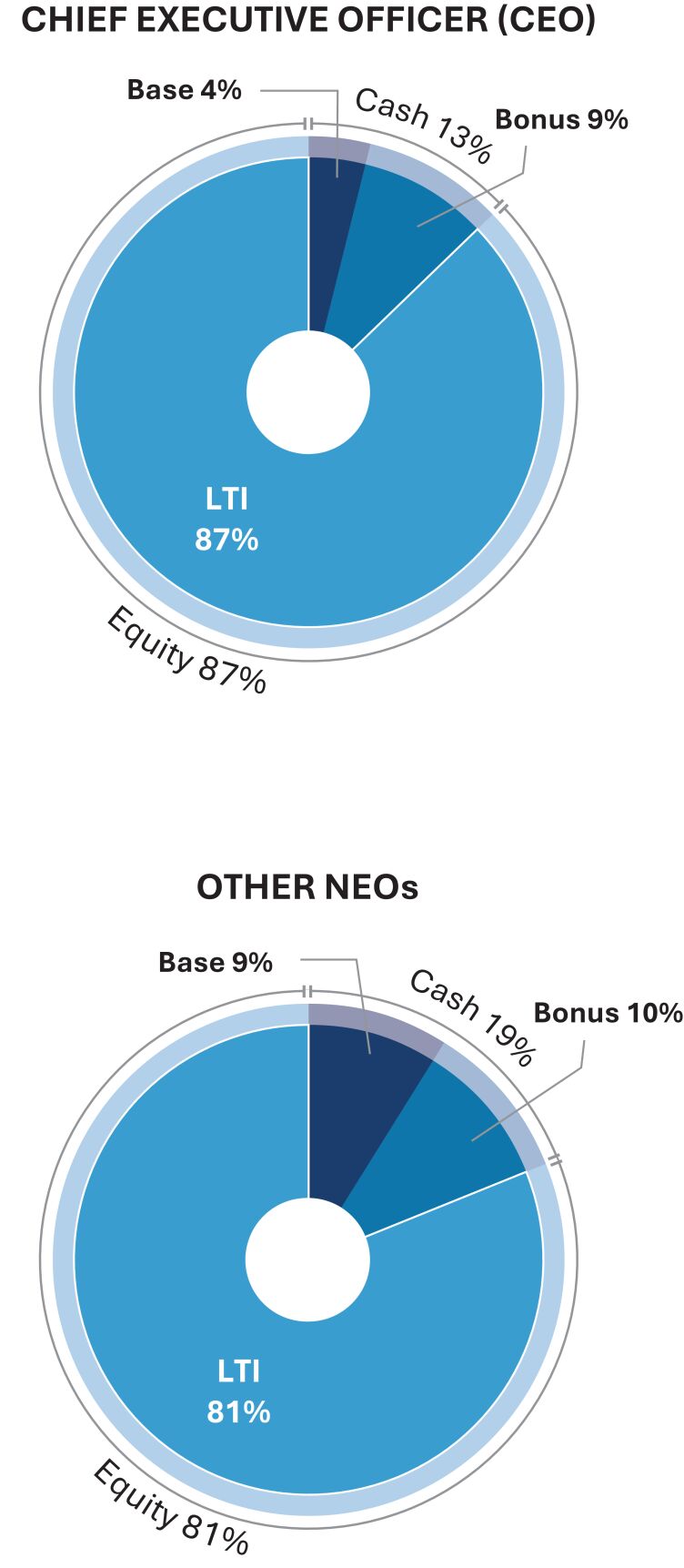
As we continue to mature as a public company, we intend that the compensation elements provided to our Named Executive Officers will continue to be designed in order to emphasize “at risk” and variable pay that helps enable us to provide a balanced set of incentives for our Named Executive Officers to meet our business objectives and drive long-term growth.
Table of Contents
| 28 | | CORE SCIENTIFIC 2026 PROXY STATEMENT Compensation Discussion and Analysis |
Executive Compensation Policies and Practices
We endeavor to maintain sound executive compensation and governance-related policies and practices that are intended to support and strengthen our compensation philosophy, goals, and objectives. The design of these policies and practices is intended to align our executive compensation program with the long-term interests of our stockholders, while also reducing compensation-related risk. The Compensation Committee evaluates our executive compensation program regularly to ensure it supports our strategic goals and objectives given the dynamic nature of our business and industry, and the markets in which we compete for executive talent. Key aspects of our executive compensation and governance-related policies and practices that were in effect in 2025 include:
| What We Do | What We Don’t Do | |||
| Independent Compensation Committee. The Compensation Committee is comprised solely of independent directors as defined under the applicable SEC rules and Nasdaq listing standards, who make the decisions with respect to our Named Executive Officers’ compensation and establish our executive compensation and governance-related policies and practices.
Independent Compensation Advisor. In 2025, the Compensation Committee retained an independent compensation consulting firm to provide information, analysis, and support for our executive compensation program and to advise on our director compensation program. The Compensation Committee believes the use of an independent compensation consultant provides additional assurance that our executive compensation program is competitive in the marketplace and reflects our executive compensation philosophy, goals, and objectives. In 2025, our independent compensation consultant performed no other consulting or other services for us.
Annual Executive Compensation Review. The Compensation Committee conducts regular reviews (but no less than annually) of our compensation strategy, including a review and determination of our compensation Peer Group used for comparative purposes. The Compensation Committee also performs an annual review of our compensation-related risk profile to ensure that our compensation programs do not encourage excessive or inappropriate risk-taking and that the level of risk is not reasonably likely to have a material adverse effect on the Company.
“Pay-for-Performance” Compensation Philosophy. Most of our Named Executive Officers’ annual target total direct compensation is linked to corporate performance. Target total direct compensation includes (i) a significant equity-based element, the value of which is dependent on performance based vesting and directly by stock price, and (ii) an incentive bonus determined by performance to pre-established metrics tied to achievement of operational and other metrics aligned with Company performance, thereby making a substantial portion of each NEO’s annual target total direct compensation opportunity dependent upon our overall, long-term success (as measured through our stock price performance). Because a significant portion of our NEOs’ compensation is in the form of “at-risk” and variable pay, they are incentivized to drive financial performance and further enhance their focus on long-term growth, and their interests are aligned with the interests of our stockholders.
Long-Term Vesting Requirements. Typically, the service-based equity awards granted to our Named Executive Officers vest over a multi-year period following the date of grant, which is consistent with current market practice and our executive officer retention objectives.
Compensation Recovery (“Clawback”) Policy. We maintain a compensation recovery policy that complies with the requirements of Exchange Act Rule 10D-1 and the applicable Nasdaq listing standards (the “Clawback Policy”). The Clawback Policy applies to erroneously-awarded incentive compensation (including equity awards) received by current and former executive officers on or after October 2, 2023 in the event that we are required to prepare an accounting restatement that corrects an error in previously issued financial statements that is material to the previously-issued financial statements, or that would result in a material misstatement if the error were corrected in the current period or left uncorrected in the current period, due to material noncompliance with any financial reporting requirement under the securities laws and a lower payment or award would have been made to such executive officer based on the restated financial results.
“Double-Trigger” Change-in-Control Arrangements. Under our employment agreements with our Named Executive Officers, all change-in-control payments and benefits are based on a “double-trigger” arrangement (that is, they require both a change in control of the Company and a qualifying termination of employment before payments and benefits are paid).
Succession Planning. The Nominating and Corporate Governance Committee reviews the risks associated with our key executive officer positions to ensure adequate succession plans are in place. |
No Special Executive Retirement Plans. We do not currently offer, nor do we have plans to offer, defined benefit pension plans or arrangements, or non-qualified deferred compensation plans or arrangements to our Named Executive Officers. Our NEOs are eligible to participate in our tax-qualified Section 401(k) retirement savings plan (the “Section 401(k) Plan”) on the same basis as our other full-time, salaried employees.
Limited Perquisites. We do not view perquisites or other personal benefits as a significant element of our executive compensation program. Consequently, we provide limited perquisites to our Named Executive Officers.
No Hedging or Pledging of our Securities. Under our Insider Trading Policy, we prohibit our employees, including our Named Executive Officers, and the non-employee members of our Board of Directors from engaging in hedging transactions or short sales, pledging our securities as collateral for a loan, purchasing our securities on margin, or placing our securities in a margin account.
No Stock Option Repricing. Our 2024 Stock Plan does not permit stock options or stock appreciation rights to be repriced to a lower exercise or strike price and certain analogous transactions without the approval of our stockholders.
| |||
Table of Contents
| CORE SCIENTIFIC 2026 PROXY STATEMENT Compensation Discussion and Analysis |
| 29 |
Compensation-Setting Process
Role of Compensation Committee
The Compensation Committee is responsible for establishing our compensation and benefits philosophy and strategy and for overseeing our compensation and benefits plans, policies, and practices generally and with respect to our Named Executive Officers. The Compensation Committee also sets the specific compensation levels for our CEO and other NEOs. Further, the Compensation Committee is also responsible for overseeing our equity compensation plans, including approving individual grants to NEOs and other members of management thereunder.
In determining our compensation strategy, the Compensation Committee reviews competitive market data to ensure that we are able to attract, motivate, reward, and retain talented executives. The Compensation Committee’s authority, duties, and responsibilities are described in its charter, which is reviewed annually by the Compensation Committee and revised as warranted. The charter is available at our corporate website under “Governance — Governance Documents — Compensation Committee Charter.”
The Compensation Committee has not established any formal policies or guidelines for allocating between currently paid and long-term compensation or between cash and non-cash compensation. In determining the amount and mix of compensation elements, and whether each element provides appropriate incentives in view of our compensation goals and objectives, the Compensation Committee relies on its judgment and experience, as well as input from its compensation consultant with respect to its Peer Group and other information derived from market surveys and other data prepared by its compensation consultant, rather than adopting a formulaic approach to compensation decisions. The Compensation Committee believes this approach is prudent to ensure it retains the flexibility necessary to adapt to changes in our business and industry, and to remain competitive in the marketplace.
In making its decisions, including with respect to the compensation of our Named Executive Officers, the Compensation Committee retains a compensation consultant (as described below) to provide support in its review and assessment of our executive compensation program.
Setting Target Total Direct Compensation
Each year, the Compensation Committee conducts a review of our executive compensation program to determine if any changes are necessary or appropriate. In carrying out its responsibilities, the Compensation Committee evaluates our compensation policies and practices for alignment with our executive compensation philosophy, develops compensation-related strategies, and makes decisions that it believes further our executive compensation philosophy, goals, and objectives, and/or align with compensation best practices.
Typically, during the first quarter of each year the Compensation Committee conducts an annual evaluation and analysis of the compensation arrangements of our Named Executive Officers. At that time, the Compensation Committee assesses the annual base salary levels, annual cash bonus opportunities, and long-term incentive compensation opportunities of our NEOs and reviews their performance and all related performance criteria.
The Compensation Committee benchmarks against other companies in our Peer Group to evaluate our compensation levels and as a decision-making tool for specific compensation decisions with respect to our Named Executive Officers. The Compensation Committee recognizes the value of considering market data when making executive compensation decisions and believes unless other circumstances warrant that NEO compensation should be roughly between the 50th and 75th percentile of companies in its Peer Group. While there may be situations in which an NEO’s compensation may fall outside this range, such as performance, experience, expertise, expected contribution, competition, retention, unavailability of comparable benchmarking metrics and other factors specific to the individual or the position, such other factors were not a material consideration of the Compensation Committee during 2025.
For 2025, the Compensation Committee evaluated the appropriate value for our NEOs’ annual target total direct compensation opportunities, consisting of annual base salary, performance-based bonus and short and long term equity. The Compensation Committee evaluated the annual target total and each of its base salary, performance bonus and short and long term equity components against the Peer Group market benchmarks from available public and survey data to establish a range for target values within various percentiles of the market with the objective of establishing each component of target total annual direct compensation between the 50th and 75th percentile of the market. The Compensation Committee then considered adjustments, in consultation with its compensation consultant, after weighing relevant considerations, including the following:
| • | our executive compensation program objectives; |
| • | our recent and projected performance against the financial, operational, and strategic goals and objectives established by the Compensation Committee and our Board of Directors; |
Table of Contents
| 30 | | CORE SCIENTIFIC 2026 PROXY STATEMENT Compensation Discussion and Analysis |
| • | each individual Named Executive Officer’s knowledge, skills, experience, qualifications, and tenure relative to other similarly situated executives at the companies in our compensation Peer Group and/or in selected broad-based compensation surveys; |
| • | the scope of each individual Named Executive Officer’s title, role, and responsibilities relative to other similarly situated executives at the companies in our compensation Peer Group and/or selected broad-based compensation surveys; |
| • | the performance of each individual Named Executive Officer, based on a subjective assessment of his or her contributions to our overall performance and ability to lead his or her business unit or function, and as measured against various strategic, operational, and management goals and objectives in each NEO’s areas of expertise and responsibility; |
| • | the potential of each individual Named Executive Officer to make future contributions to our long-term financial, operational, and strategic goals and objectives and the ability to enhance stockholder value creation; |
| • | the retention risk (and related replacement cost) of each individual Named Executive Officer in view of factors such as title and area of expertise; |
| • | our CEO’s compensation relative to that of our other Named Executive Officers, and compensation parity among our other NEOs; |
| • | our financial performance relative to both our compensation Peer Group (a formally established group used for pay benchmarking) and our performance peers (the component companies of the Russell 2000 Index); |
| • | our executive hiring and retention considerations; |
| • | evolving pay practices in our industry or primary geographic areas and changes to our business and industry; |
| • | the compensation practices of the companies in our compensation Peer Group and in selected broad-based compensation surveys and the positioning of each Named Executive Officer’s compensation in a ranking of peer company compensation levels based on an analysis of competitive market data; and |
| • | the recommendations of our CEO with respect to the compensation of our Named Executive Officers (except with respect to his own compensation). |
No one of these additional considerations is determinative in setting compensation levels, nor is the impact of any individual consideration on the determination of pay levels quantifiable when considered in the context of the impact of, or when determining adjustments to, the weight placed on the importance of setting executive compensation between the 50th and 75th percentile of the Peer Group.
Role of Management
In discharging its responsibilities, the Compensation Committee works with members of our management, including our CEO. Our management assists the Compensation Committee by providing information on corporate and individual performance and management’s perspective on compensation matters. The Compensation Committee solicits and reviews management’s proposals with respect to the structure of our executive compensation program, as well as our CEO’s recommendations for adjustments to the total annual cash compensation opportunities of our other NEOs, long-term incentive compensation opportunities, and other compensation-related matters for our other Named Executive Officers, based on our CEO’s evaluation of their performance for the prior year. In addition, at the request of the Compensation Committee, other senior management personnel may provide performance and compensation information to the Compensation Committee to inform its compensation decisions. Consistent with the applicable Nasdaq listing standards, the Compensation Committee is ultimately responsible for approving the compensation paid to our NEOs.
At the beginning of each year, our CEO reviews the performance of our other Named Executive Officers, based on their overall performance and performance against business goals and objectives established for them for the prior year, and then shares these evaluations with, and makes recommendations to, the Compensation Committee for each element of compensation as described above. The annual business goals and objectives for each Named Executive Officer are to be developed through mutual discussion and agreement between our CEO and the NEO and are also reviewed with our Board of Directors.
The Compensation Committee reviews and discusses our CEO’s recommendations and considers them as one factor in determining and approving our Named Executive Officers’ annual target total direct compensation opportunities. From time to time, our CEO also attends meetings of our Board of Directors and the Compensation Committee at which executive compensation matters are addressed, except for discussions involving his own compensation.
Role of Compensation Consultant
In 2025, the Compensation Committee engaged Compensia, Inc. (“Compensia”) to serve as its independent compensation consultant. Compensia reported directly to the Compensation Committee and served at the discretion of the Compensation Committee. Beginning in January 2026, the Compensation Committee changed compensation consultants and retained Pay Governance, LLC as its independent compensation consultant regarding compensation decisions for 2026.
Table of Contents
| CORE SCIENTIFIC 2026 PROXY STATEMENT Compensation Discussion and Analysis |
| 31 |
During 2025, Compensia attended the meetings of the Compensation Committee (both with and in executive session without management present) as requested and provided various services, which included the following:
| • | reviewing and analyzing the annual base salary levels, target annual cash bonus opportunities, and long-term incentive compensation opportunities of our executive officers as compared to competitive market data drawn from our 2024 compensation peer group and/or selected broad-based compensation surveys; |
| • | reviewing and summarizing competitive market compensation practices for the chief financial officer and other executive positions; |
| • | conducting a review of the report of proxy advisors (including Institutional Shareholder Services and Glass Lewis) with respect to their recommendations on matters to be submitted for stockholder approval at the 2025 Annual Meeting of Stockholders; |
| • | reviewing and analyzing the competitive market with respect to the compensation arrangements for the members of a special committee of the board of directors formed to evaluate and make recommendations on various issues arising in connection with a proposed merger or other acquisition and preparing a report presenting its findings and summarizing best practices concerning the scope, jurisdiction, and duration of such a committee; and |
| • | providing updates on regulatory developments and market trends. |
Compensia also coordinated with our management for data collection and job matching for our Named Executive Officers. In 2025, Compensia did not provide any other services to us.
The Compensation Committee has evaluated its relationship with Compensia to ensure that it believes that such compensation consulting firm is independent from our management. This review process included a review of the services that Compensia provided, the quality of those services, and the fees associated with the services provided during 2025. Based on this review, as well as consideration of the factors affecting independence set forth in Exchange Act Rule 10C-1(b)(4), Rule 5605(d)(3)(D) of the Nasdaq Marketplace Rules, and such other factors as were deemed relevant under the circumstances, the Compensation Committee evaluated Compensia’s independence and determined that no conflict of interest had arisen as a result of the work performed by Compensia, including the work performed by the individual compensation advisors employed by Compensia.
Competitive Positioning
The Compensation Committee believes that peer group comparisons are useful guides to measure the competitiveness of our executive compensation program and related policies and practices. To assess our executive compensation against the competitive market, the Compensation Committee reviews and considers the compensation levels and practices of a select group of peer companies. The competitive data drawn from this Peer Group is only one of several factors that the Compensation Committee considers, however, in making its compensation decisions for our Named Executive Officers.
In November 2024, given the Company’s transformation into the HPC hosting operation business, the Compensation Committee reviewed our compensation peer group for 2025 and determined that adjustments to the composition of the peer group were warranted to account for the significant revenue and other growth prospects afforded by the HPC hosting operation segment and the different customer, employment, financial and operational challenges posed by the segment. Compensia and the Compensation Committee specifically considered and weighed the following primary criteria, along with other factors:
| Geography and Public Company Status |
Publicly traded companies primarily headquartered in the United States and traded on a major U.S. stock exchange | |
| Industry |
Companies within the information technology, financial, and industrial sectors, including applications/systems software, data center REITs, data processing and outsourced services, interactive media and services, internet services and infrastructure, investment banking and brokerage, semiconductors, and transaction and payment processing services | |
| Revenue |
Companies with similar revenue to ours — within a range of approximately 0.33x to approximately 3.0x the midpoint of our prior four fiscal quarters’ revenue of approximately $575 million | |
| Market Capitalization |
Companies with similar market capitalization to ours — within a range of approximately 0.25x to approximately 4.0x of our assumed market capitalization of approximately $6 billion | |
Table of Contents
| 32 | | CORE SCIENTIFIC 2026 PROXY STATEMENT Compensation Discussion and Analysis |
Based on a review of the report and analysis prepared by Compensia, in November 2024 the Compensation Committee approved the following compensation Peer Group for 2025:
| Box |
Robinhood Markets |
Manhattan Associates | ||
| CleanSpark |
SolarWinds |
nCino | ||
| Mara Holdings |
VeriSign |
SentinelOne | ||
| MicroStrategy |
Altair Engineering |
Zeta Global Holdings | ||
| Okta |
DigitalOcean Holdings |
Rambus | ||
| Elastic N.V. |
Informatica |
Intapp | ||
| Riot Platforms |
For purposes of its 2025 review of our executive compensation program, the Compensation Committee used data drawn from the companies in our compensation peer group, as well as data drawn from a custom data cut consisting of publicly-traded U.S.-based hardware and software technology companies with revenues up to approximately $1.5 billion from the Radford Global Technology Survey database, to analyze the compensation of our NEOs and to evaluate the competitive market for purposes of making decisions about their annual target total direct compensation opportunities, including their long-term incentive compensation opportunities.
The Compensation Committee reviews our compensation Peer Group periodically and makes adjustments to its composition if warranted, taking into account changes in both our business and the businesses of the companies in the Peer Group.
Primary Compensation Elements
The design of our executive compensation program is intended to be competitive in the marketplace, and to appropriately balance our goal to pay our Named Executive Officers based on their performance, reward the achievement of strategic initiatives, attract and retain talented individuals, and align the interests of our NEOs and our stockholders. For 2025, the primary elements of our executive compensation program were annual base salary, annual cash bonus opportunities, and long-term incentive compensation opportunities in the form of equity awards.
| Compensation Elements |
Compensation Form | Compensation Objectives | ||
| Annual Base Salary |
Fixed cash compensation | Attract and retain top talent through market-competitive base salary levels that are commensurate with our Named Executive Officers’ roles and responsibilities | ||
| Annual Cash Bonuses |
Variable cash compensation based on actual performance as measured against pre-established financial, operational, and strategic performance goals and objectives | Incentivize achievement of business goals and objectives as set forth in our annual operating plan and, thereby, reward short-term performance results that support our long-term ability to create stockholder value | ||
| Long-Term Incentive Compensation |
Variable equity compensation in the form of PSU awards, which are earned based on both pre-established performance goals and objectives and time-based vesting requirements, and time-based RSU awards, which vest over a three or four-year period | Motivate and reward achievement of long-term performance goals and align the economic interests of our Named Executive Officers and our stockholders | ||
Our Named Executive Officers were also eligible to participate in the standard employee health and welfare benefit programs and our Section 401(k) Plan generally to the same extent as our other full-time, salaried employees.
Annual Base Salary
The annual base salaries of our Named Executive Officers are intended to attract and retain highly talented individuals by providing the fixed portion of their annual target total direct compensation opportunities. We use base salary to provide each NEO with a specified level of cash compensation during the year with the expectation that he or she will perform his or her responsibilities to the
Table of Contents
| CORE SCIENTIFIC 2026 PROXY STATEMENT Compensation Discussion and Analysis |
| 33 |
best of his or her ability and in our best interests. Generally, we establish the initial annual base salaries of our Named Executive Officers through arm’s-length negotiation at the time of hire, taking into account the individual’s position, qualifications, experience, competitive market data, and the annual base salaries of our other Named Executive Officers.
Thereafter, the Compensation Committee reviews the annual base salaries of our Named Executive Officers each year as part of its executive compensation review, with input from our CEO (except with respect to his own base salary) and the Compensation Committee’s compensation consultant, and makes adjustments, subject to the employment agreements, as it determines to be reasonable and necessary to reflect the scope of each NEO’s performance, individual contributions and responsibilities, position in the case of a promotion, annual target total direct compensation opportunity, and competitive market conditions.
In April 2025, the Compensation Committee reviewed the annual base salaries of our Named Executive Officers after considering a competitive market analysis prepared by its compensation consultant as well as the other factors described in “Compensation-Setting Process — Setting Target Total Direct Compensation” above. Following this review, the Compensation Committee increased the annual base salaries of our CEO and Mr. DuChene in recognition of the highly competitive and challenging marketplace for skilled and seasoned executive officers and to reflect an appropriate cost-of-living adjustment. As their annual base salaries were previously approved as set forth in the Nygaard Employment Agreement and the Sterling Transition Agreement, the Compensation Committee did not review the annual base salaries for Mr. Nygaard and Ms. Sterling, respectively.
Our Named Executive Officers’ annual base salaries, effective January 1, 2025, as approved by the Compensation Committee were as follows:
| Named Executive Officer |
2024 Annual Base Salary ($) |
2025 Annual Base Salary ($) |
Percentage Increase (%) |
|||||||||
| Mr. Sullivan |
$ | 625,000 | $ | 825,000 | 32.0 | % | ||||||
| Mr. Nygaard |
— | $ | 600,000 | — | ||||||||
| Mr. DuChene |
$ | 500,000 | $ | 525,000 | 5.0 | % | ||||||
| Ms. Sterling |
$ | 500,000 | $ | 500,000 | — | |||||||
Mr. Sullivan received a more significant base salary increase in 2025 to better align his compensation with the Committee’s pay philosophy, which targets total direct compensation between the market median and 75th percentile of our compensation Peer Group. Prior to this adjustment, Mr. Sullivan’s salary had been positioned near the 25th percentile of the Peer Group. In recognition of his exceptional leadership in guiding the Company through its emergence from bankruptcy and successfully repositioning it as a leading high-performance computing and AI infrastructure operator, the Committee determined that a competitive salary level was appropriate and necessary to reflect both his contributions and the Company’s transition to a growth-oriented public company.
The annual base salaries of our Named Executive Officers during 2025 are reflected in the “Summary Compensation Table” below.
Annual Cash Bonuses
We use annual cash bonuses to motivate our Named Executive Officers to achieve our annual business goals and objectives, consistent with our annual operating plan. These bonuses align with our pay-for-performance philosophy, as payouts are contingent on achieving pre-established financial, operational, and/or strategic goals. They also support retention, as cash bonuses are a standard element in our industry, and promote stockholder alignment by tying rewards to outcomes that drive long-term value.
In April 2025, the Compensation Committee approved the terms of our annual cash bonus plan (the “2025 Bonus Plan”), including performance metrics, threshold, target, and maximum achievement levels, and target bonus opportunities for Messrs. Sullivan and DuChene. Mr. Nygaard’s target opportunity was set under his employment agreement, with the same performance metrics applied. Per the transition agreement, Ms. Sterling was not eligible for the 2025 Bonus Plan. Ms. Sterling was paid a discretionary bonus for 2025 for her continuing transition services during 2025. See “Summary Compensation Table” for amounts actually paid for 2025.
Target Annual Cash Bonus Opportunities
For 2025, the Compensation Committee set target bonus opportunities (as a percentage of base salary) after reviewing a competitive market analysis from its compensation consultant and other factors described in “Compensation-Setting Process — Setting Target Total Direct Compensation” above. Targets for Messrs. Sullivan and DuChene remained at 2024 levels, while Mr. Nygaard’s was established pursuant to his employment agreement.
Table of Contents
| 34 | | CORE SCIENTIFIC 2026 PROXY STATEMENT Compensation Discussion and Analysis |
Our participating Named Executive Officers’ target annual cash bonus opportunities for 2025 were as follows.
| Named Executive Officer |
2025 Annual Base Salary ($) |
2025 Target Annual Cash Bonus Opportunity (as a percentage of annual base salary) (%) |
2025 Target ($) |
|||||||||
| Mr. Sullivan |
$ | 825,000 | 125 | % | $ | 1,031,250 | ||||||
| Mr. Nygaard |
$ | 600,000 | 100 | % | $ | 600,000 | ||||||
| Mr. DuChene |
$ | 525,000 | 100 | % | $ | 525,000 | ||||||
Corporate Performance Metrics
In April 2025, the Compensation Committee selected a series of quantitative (ideal hashrate utilization and controllable expenses) and qualitative (various operational compliance goals and strategic objectives described in the table below) as the performance metrics for the 2025 Bonus Plan. For purposes of measuring the achievement of these performance metrics, the following specific criteria were to be applied:
| Performance Metrics |
Weight | |||||||
| (Threshold Level) (80%) |
(Target Level) (100%) |
(Maximum Level) (200%) | ||||||
| Operational efficiency at Ideal Hashrate at 85% of plan1 | Operational efficiency at Ideal Hashrate at 92% of plan | Operational efficiency at Ideal Hashrate at 97% of plan | 33.3% | |||||
| Controllable Expenses at greater than 100% of budget and less than 110% of budget2 | Controllable Expenses at budget | Controllable Expenses equal to or less than 95% of budget | 33.3% | |||||
| Individual Management Performance contribution to Company Objectives | Individual Management Performance contribution to Company Objectives | Individual Management Performance contribution to Company Objectives | 33.3% | |||||
| (1) | Ideal Hashrate is the optimal uptime for operating Company digital asset mining machines not in repair taking into account availability and price of power, mandatory and necessary curtailments. Plan is defined as the aggregate expected performance of all units in the fleet based on the manufacturer’s specifications of theoretically achievable hashrate for all installed and up and running chips. |
| (2) | Controllable expenses were budgeted at $151,300,000. Controllable expenses are total expenses for the calendar year, excluding depreciation and amortization, stock-based compensation, cash incentive bonus, advisor fees and expenses and non-recurring start-up costs associated with the high-density colocation computing business. Items excluded from controllable expenses include stock-based compensation, depreciation and amortization, advisor fees, colocation org start-up costs, non-controllable legal expenses, and employee bonuses. Controllable expenses is a non-GAAP financial measure. For a full reconciliation of controllable expenses for the year ended December 31, 2025 to total costs and expenses, the most directly comparable financial measure stated in accordance with GAAP, please see Appendix A to this proxy statement. |
The Compensation Committee selected each of these items as the performance metrics for the 2025 Bonus Plan because, in its view, they were consistent with the near-term goals and objectives of our annual operating plan, while furthering our progress on achieving our long-term strategic goals and objectives. In the case of the quantitative performance metrics, the selected performance levels under the 2025 Bonus Plan were greater than the amounts achieved during 2024 and represented an aggressive level of performance that the Compensation Committee believed our management team could achieve only with exceptional effort and performance in light of the Company’s capital structure and in the projected business environment. In the case of the qualitative performance metric, the Compensation Committee believed that measuring each Named Executive Officer’s individual contribution to our progress with respect to our overall Company goals and objectives for 2025 was best determined on a discretionary basis after the end of the year when our achievements could be evaluated in the context of the business environment in which the Company operated, the Company’s capital structure, the limitations imposed on the Company by its Plan of Reorganization, and other competitive market actions and pressures.
For purposes of the 2025 Bonus Plan, payment of the earned portion of the 2025 target annual cash bonus opportunity to a participating Named Executive Officer was subject to the Named Executive Officer’s continued service as an employee of the Company through the date of payment.
Table of Contents
| CORE SCIENTIFIC 2026 PROXY STATEMENT Compensation Discussion and Analysis |
| 35 |
2025 Cash Bonus Payments
To determine the 2025 cash bonus payments, the Compensation Committee reviewed the Company’s financial performance for 2025, including the determination that the Company had achieved “ideal hashrate” in excess of 98%, exceeding the maximum performance metric of 97% set for the highest performance level (200%) for 1/3 of the bonus amount; and recorded controllable expense at a level that was 92% of the Company’s budgeted amount, an expense level that out-performed the maximum performance metric of expense below 95% of the Company’s budgeted amount established for the highest performance level (200%) for 1/3 of the bonus amount. The Compensation Committee also determined that the performance of each of the NEOs exceeded expectations and contributed significantly to the performance of the Company to the established metrics. As a result, the Compensation Committee determined that the Company had met the maximum performance threshold for all three of the performance metrics established for the 2025 annual bonus payment and authorized a payout of 200% of the target amount for each of the NEOs eligible to receive a bonus pursuant to the 2025 annual bonus plan.
The following were, among others, considerations taken into account by the Compensation Committee for purposes of the individual management performance contribution to Company objectives:
| • | Increased available electrical power pipeline to approximately 1.5 gigawatts |
| • | Increased medium voltage energized megawatts to approximately 350 MW as of March 2, 2026 |
| • | Achieved one million square feet of constructed data center building shells |
| • | TSR exceeded 300%, which ranked us in excess of the 75th percentile relative to the companies comprising the Russell 2000 Index |
| • | Contracted subject to diligence three additional powered sites in diverse geographic markets |
| • | Finalized settlement of all remaining Chapter 11 claims to complete the final distribution of reserved shares |
| • | Execution of the proposed merger with CoreWeave, transition to standalone business plan following rejection of the proposed merger by the Company’s stockholders and the overall increase in the value of the Company. |
| • | Enhancement to management team, transition to KPMG and back to office initiatives |
In evaluating the appropriate level of payment, the Compensation Committee was also mindful of the fact that the annual bonus programs of many Peer Group members rely heavily on subjective and qualitative determinations and, moreover, that a primary and important focus of management during 2025, and one not meaningfully reflected in performance relative to the quantitative goals, was navigating the failed merger with CoreWeave, which ultimately led to a sharp increase in the Company’s share price. Accordingly, the Compensation Committee believes that the payment of the 2025 cash bonuses was consistent with our “pay-for-performance” philosophy and our intention to reward the achievement of the financial, operational, and strategic objectives as reflected in our annual operating plan.
Based on its assessment of all these quantitative and qualitative factors, the Compensation Committee awarded the following 2025 cash bonus payments to our participating Named Executive Officers:
| Named Executive Officer |
2025 Target Annual Cash ($) |
2025 Actual Cash Bonus ($) |
2025 Actual Cash Bonus (as a percentage of target annual cash bonus opportunity) (%) |
|||||||||
| Mr. Sullivan |
$ | 1,031,250 | $ | 2,062,500 | 200 | % | ||||||
| Mr. Nygaard |
$ | 600,000 | $ | 1,200,000 | 200 | % | ||||||
| Mr. DuChene |
$ | 525,000 | $ | 1,050,000 | 200 | % | ||||||
Long-Term Incentive Compensation
We provide long-term incentive compensation opportunities in the form of equity awards to our Named Executive Officers. Equity awards are an integral element of our executive compensation program and are designed to assist us in achieving our executive compensation goals and objectives. Long-term incentive awards are granted in the form of PSU awards and RSU awards which provide our Named Executive Officers with the opportunity to earn and receive shares of our common stock upon vesting and settlement.
The Compensation Committee believes that equity awards further our “pay-for-performance” philosophy since the value of the awards is, in the case of RSU awards, based on the market price of our common stock and, in the case of PSU awards, earned and realized only if we have achieved specific pre-established financial, operational, and/or strategic goals and objectives that drive our
Table of Contents
| 36 | | CORE SCIENTIFIC 2026 PROXY STATEMENT Compensation Discussion and Analysis |
business and create stockholder value and, therefore, serve to reward the achievement of these goals and objectives. Further, the design of our equity awards is intended to meet our retention objectives because the economic value of these awards can only be realized upon vesting following the satisfaction of long-term service periods.
In April 2025, the Compensation Committee approved long-term incentive compensation opportunities for Messrs. Sullivan and DuChene under our annual equity grant program. To determine the target values and mix of these awards, the Committee considered a competitive market analysis from its compensation consultant, along with the other factors described in “Compensation-Setting Process — Setting Target Total Direct Compensation” above.
In a deliberate shift to emphasize performance-based incentives, the Committee allocated approximately two-thirds of each executive’s target award value to PSUs and one-third to RSUs. This represents a significant increase in the performance-based portion compared to 2024, when the mix was one-quarter PSUs and three-quarters RSUs (excluding Emergence Awards). The Committee viewed this enhanced weighting toward PSUs as appropriate, given the executives’ critical roles in driving our long-term financial, operational, and strategic objectives.
The annual equity awards granted to Messrs. Sullivan and DuChene in April 2025 were as follows:
| Named Executive Officer |
2025 Annual PSU Award (#) (1) |
2025 Annual RSU Award (#) (1) |
2025 Annual Equity Award Aggregate Target Value ($) |
|||||||||
| Mr. Sullivan |
1,332,117 | 665,985 | $ | 13,687,000 | ||||||||
| Mr. DuChene |
389,343 | 194,600 | $ | 4,000,000 | ||||||||
| (1) | The number of PSUs and RSUs subject to each 2025 annual equity award granted to Messrs. Sullivan and DuChene, respectively, was equal to (i) the target value of the 2025 Annual RSU Award divided by (ii) the closing market price of our common stock on April 15, 2025, which was $6.85 per share, with approximately two-thirds of each Named Executive Officer’s target value allocated to the 2025 PSU award and the remaining one-third allocated to the RSU award. |
Annual PSU Awards
The 2025 Annual PSU Awards are eligible to be earned over a three-year performance period consisting of three annual measurement periods (each, a “Measurement Period”), with one-third of the PSUs (plus any unearned portions from prior Measurement Periods, as applicable) eligible to be earned and vest based on performance for each respective calendar year (2025, 2026, and 2027).
In each case, the number of PSUs earned depends on achievement against pre-established performance metrics, with vesting generally subject to the Named Executive Officer’s continued employment through the end of the applicable Measurement Period.
For the “new customer acquisition involving a total of 100 megawatts” metric, the Compensation Committee may adjust the achievement level upward or downward based on factors such as customer identity, site location, total megawatts, contract profitability, contract length and other material terms, and other considerations not determinable in advance.
The pre-established performance metrics for the 2025 Annual PSU Awards for the first Measurement Period were as follows:
| Performance Metrics |
||||||||
| (Threshold Level) (100%) |
(Target Level) (200%) |
(Maximum Level) (300%) |
Weight | |||||
| Relative TSR compared to the Russell 2000 that is greater than 25% and less than 50% (grant date to year-end) | Relative TSR compared to the Russell 2000 that is 50% or greater than and less than 75% (grant date to year-end) | Relative TSR compared to the Russell 2000 that is 75% or greater (grant date to year-end) | 33.3% | |||||
| Aggregate Energized Megawatts growth to plan equal to 95% (powered site completion on or before March 15, 2026) | Aggregate Energized Megawatt growth to plan equal to 100% (powered site completion on or before March 15, 2026) | Aggregate Energized Megawatt growth to plan equal to 105% (powered site completion on or before December 31, 2025) | 33.3% | |||||
| Compensation Committee discretion | New customer(s) acquisition total of 100 megawatts | Compensation Committee discretion | 33.3% | |||||
These performance metrics were designed to incentivize the NEOs to focus on acquisition of additional land and electrical power that can be sold to customers increasing the Company’s revenue growth and customer acquisition and development creating customer diversification, stabilizing long term revenue and increasing the Company’s stock price and enhancing the Company’s long term return on its shareholder’s investment in the Company..
Table of Contents
| CORE SCIENTIFIC 2026 PROXY STATEMENT Compensation Discussion and Analysis |
| 37 |
On March 20, 2026, the Compensation Committee determined that, for purposes of the first Measurement Period, (i) our TSR for the period from April 28, 2025 (the date the metrics were finally approved by the Compensation Committee) to December 31, 2025 compared to the Russell 2000 was 84.8% and (ii) we had achieved aggregate energized megawatts growth to equal to 142% of our annual operating plan (as of March 15, 2026), Accordingly, the weighted percentage achievement levels for each of these two performance metrics were 300% and 200%, respectively. In addition, the Compensation Committee determined that the customer attainment metric was not met and achievement for that metric was zero. Accordingly, the Compensation Committee determined that for purposes of the first Measurement Period, each of Messrs. Sullivan and DuChene had earned 167% of the target number of PSUs subject to their 2025 Annual PSU Awards for the first Measurement Period (i.e., with respect to the PSUS attributable to calendar year 2025), with each of such earned PSUs vested and settled in March 2026 for the number of shares of our common stock set forth next to their name in the following table):
| Named Executive Officer |
2025 Annual PSU Award – (#) |
PSUs Settled for Shares of Common Stock (#) |
||||||
| Mr. Sullivan |
741,545 | 741,545 | ||||||
| Mr. DuChene |
216,734 | 216,734 | ||||||
As provided under their 2025 Annual PSU Award agreements, each of Messrs. Sullivan and DuChene were eligible to receive such shares of common stock as a result of their being continuously employed with us through the end of the first Measurement Period. The number of earned PSUs for the second (calendar year 2026) and third (calendar year 2027) Measurement Periods will be determined based on the degree to which the applicable pre-established performance levels are achieved during the second and third Measurement Periods, respectively, and Messrs. Sullivan and DuChene’s satisfaction of their continued employment or service requirements.
Annual RSU Awards
The 2025 Annual RSU Awards vest over three years with one-third of the RSUs subject to an award vesting on April 15, 2026 (the first anniversary of the date of grant), and the remaining two-thirds of such RSUs vesting in eight substantially equal quarterly installments thereafter, subject to the Named Executive Officer’s continuous service to the Company on each vesting date. Each vested RSU is subject to conversion on a one-for-one basis into shares of our common stock upon settlement.
The equity awards granted to our Named Executive Officers during 2025, including the RSU award granted to Mr. Nygaard in connection with his appointment as our CFO, are set forth in the “Summary Compensation Table” and the “2025 Grants of Plan-Based Awards Table” below.
Other Compensation Elements
Health and Welfare Benefit Plans
Our Named Executive Officers are eligible to participate in the same Company-sponsored health and welfare benefits plans subject to the same terms and eligibility requirements as our other full-time, salaried employees. These benefits include medical, dental, vision, life (including accidental death and dismemberment), an employee assistance plan, health and dependent care flexible spending accounts, and disability insurance plans.
We also sponsor the Section 401(k) Plan that provides eligible employees, including our Named Executive Officers, with an opportunity to save for retirement on a tax-advantaged basis, subject to the limits imposed by the Internal Revenue Code (the “Code”). U.S. employees who have attained at least 18 years of age are generally eligible to participate in the Section 401(k) Plan as of the first day of the calendar month following one month of service. Participants may make pre-tax or post-tax contributions to the Section 401(k) Plan or individual Roth plan, subject to the statutorily prescribed annual limits on contributions under the Code. Currently, we provide a safe harbor enhanced match contribution of 100% of participants deferrals up to 6% of eligible plan compensation. Annual match contributions are limited to the 6% match cap multiplied by IRS maximum 401(k) compensation as indexed. A participant becomes 100% vested in our Company matching contributions immediately and is 100% vested in his or her pre-tax or post-tax deferrals when contributed.
We design our employee benefits programs to be affordable and competitive in relation to market practices, and compliant with applicable laws and practices. We adjust our employee benefits programs as needed based upon changes in applicable laws and market practices.
Table of Contents
| 38 | | CORE SCIENTIFIC 2026 PROXY STATEMENT Compensation Discussion and Analysis |
Perquisites and Other Personal Benefits
Currently, we do not view perquisites or other personal benefits as a significant component of our executive compensation program. Accordingly, we do not provide significant perquisites or other personal benefits to our Named Executive Officers except as generally made available to our employees or in situations where we believe it is appropriate to assist an individual in the performance of his or her duties, to make him or her more efficient and effective, and for recruitment, relocation and retention purposes. The Summary Compensation Table below sets forth the perquisites and other personal benefits received by each of our Named Executive Officers.
Employment Agreements
We have entered into written employment agreements with Messrs. Sullivan, Nygaard, and DuChene. We believe that these employment agreements were necessary to secure the continued service of these individuals in a highly competitive job market and to integrate the executive officer into our executive compensation structure that we have maintained since our initial public offering. Each of these employment agreements provides for an initial term of employment (three years in the case of Mr. Sullivan and one year in the case of Messrs. Nygaard and DuChene) which automatically renews for successive one-year periods following the initial term (unless notice is provided by either party) and sets forth the initial compensation arrangements for the Named Executive Officer. These arrangements include an initial annual base salary, eligibility to participate in our annual cash bonus plan with the amount, terms, and conditions of such participation to be determined in the sole discretion of the Compensation Committee, eligibility to receive equity or equity-based incentive awards under the 2024 Stock Plan, and eligibility to participate in our employee health, retirement, and welfare benefit plans, and to receive such other fringe benefits, as we may in our discretion make available to our executive officers generally, subject to all present and future terms and conditions of such employee benefit plans and other fringe benefits.
These employment agreements also provide the Named Executive Officers with certain payments and benefits in the event of a termination of employment, including certain terminations of employment in connection with a change in control of the Company. These post-employment compensation arrangements are discussed in “Post-Employment Compensation” below.
For a more detailed description of each of these employment agreements, see “Employment Agreements with Named Executive Officers” below.
Sterling Transition Agreement
In November 2024, we entered into the Sterling Transition Agreement which provided that Ms. Sterling would remain employed with the Company to ensure an efficient transition of her responsibilities until May 1, 2025 or such later date as mutually agreed between the parties (ultimately agreed as January 16, 2026). The Sterling Transition Agreement sets forth the compensation arrangements for Ms. Sterling, including her annual base salary during the transition period, a $500,000 cash retention bonus if she remained continuously employed by us through December 31, 2024 (which was earned and paid in May, 2025, a one-time RSU award covering 318,613 RSUs which vested on March 31, 2025 (and converted on a one-for-one basis into an equivalent number of shares of our common stock), and eligibility to participate in our employee health, retirement, and welfare benefit plans, and to receive such other fringe benefits, as we may in our discretion make available to our executives generally, subject to all present and future terms and conditions of such employee benefit plans and other fringe benefits. Pursuant to the Sterling Transition Agreement, Ms. Sterling also executed a general release of claims in favor of the Company and affirmed her agreement to other customary non-disparagement, confidentiality, and cooperation covenants. Ms. Sterling continued to perform transition services as required by the Company beyond the separation transition date agreed with the Company. As a result, the Company compensated Ms. Sterling for her efforts during 2025 as if she were a member of senior management during the period even though the Company was not required to do so.
Post-Employment Compensation
The employment agreements we have entered into with Messrs. Sullivan, Nygaard, and DuChene provide for certain protections in the event of death, disability, and certain involuntary terminations of employment, including an involuntary termination of employment in connection with a change in control of the Company, in exchange for a general release of claims and compliance with a confidentiality covenant as set forth in their respective employment agreements.
We believe that these post-employment compensation arrangements provide reasonable compensation in the form of severance pay and certain limited benefits to these Named Executive Officers if they leave our employ under certain circumstances to facilitate their transition to new employment. Further, we seek to mitigate any potential employer liability and avoid future disputes or litigation by requiring such NEOs, upon departure, to execute a separation and release agreement in a form prescribed by us providing for a general release of all claims as a condition to receiving post-employment compensation payments or benefits.
Table of Contents
| CORE SCIENTIFIC 2026 PROXY STATEMENT Compensation Discussion and Analysis |
| 39 |
Under these post-employment compensation arrangements, all payments and benefits in the event of a change in control of the Company are payable only if there is a connected loss of employment by Messrs. Sullivan, Nygaard, and DuChene, as applicable (a so-called “double-trigger” arrangement). We use this double-trigger arrangement to protect against the loss of retention value following a change in control and to avoid windfalls, both of which could occur if vesting of either equity or cash-based awards accelerated automatically as a result of the transaction.
Pursuant to our employment agreements with Messrs. Sullivan, Nygaard, and DuChene, in the event of a change in control of the Company, to the extent Section 280G or 4999 of the Code is applicable to one of these Named Executive Officers, he will be entitled to receive either (i) payment of the full amount specified in his employment agreement to which he is entitled or (ii) payment of such amount that is economically less than the amount that would otherwise trigger the excise tax imposed by Section 4999 of the Code, depending on which results in the Named Executive Officer receiving a higher amount after taking into account all federal, state, local, and foreign income, employment, and other taxes and the excise tax imposed by Section 4999 of the Code.
We do not currently make available excise tax reimbursement payments (including “gross-ups”) relating to a change in control of the Company and have no such obligations in place with respect to any of our Named Executive Officers.
We believe that having in place reasonable and competitive post-employment compensation arrangements, including in the event of a qualifying termination of employment in connection with or within specified periods before or after a change in control of the Company, are essential to offering competitive compensation packages and for attracting and retaining highly qualified executives. We further believe that these arrangements help maintain these NEOs’ continued focus on their assigned duties to maximize stockholder value if there is a potential change in control transaction and mitigate the risk of subsequent disputes or litigation. The Compensation Committee does not consider the specific amounts payable under the post-employment compensation arrangements when determining the compensation of our Named Executive Officers.
For detailed descriptions of the post-employment compensation arrangements with Messrs. Sullivan, Nygaard and DuChene and an estimate of the potential payments and benefits payable to these Named Executive Officers under these arrangements, see “Potential Payments upon Termination or Change in Control” below.
Other Compensation Policies
Compensation Recovery (“Clawback”) Policy
We maintain a Policy on Recoupment of Incentive Compensation (the “Clawback Policy” referenced above) that complies with the requirements of Exchange Act Rule 10D-1 and Rule 5608 of the Nasdaq Stock Market listing standards pursuant to which we are required to seek recovery of erroneously-awarded “incentive-based compensation” (including equity awards) “received” by any current or former “executive officer” (as each such term is defined in the Clawback Policy) on or after October 2, 2023 in the event that we are required to prepare an accounting restatement to correct an error in previously issued financial statements that is material to the previously-issued financial statements, or that would result in a material misstatement if the error were corrected in the current period or left uncorrected in the current period, due to material noncompliance with any financial reporting requirement under the securities laws and a lower payment or award would have been made to such executive officer based upon the restated financial results.
Under the Clawback Policy, recovery is required regardless of whether the executive officer or any other person was at fault or responsible for the accounting errors that contributed to the need for the accounting restatement or engaged in misconduct. For incentive-based compensation based on our stock price or total stockholder return, where the amount of erroneously-awarded compensation is not subject to mathematical recalculation directly from the information in the restated financial results, the recovery to be sought by us will be determined by the Compensation Committee based on a reasonable estimate of the effect of the restatement on our stock price or total stockholder return upon which the erroneously-awarded compensation was received.
In February 2025, during the preparation of the consolidated financial statements for the year ended December 31, 2025, we determined that property, plant and equipment was overstated as a result of the improper continued capitalization of carrying values of assets committed to demolition in connection with the conversion of certain facilities from digital asset mining operations to high-performance computing colocation infrastructure, which impacted our previously issued consolidated financial statements as of and for the year ended December 31, 2024, as well as the condensed consolidated financial statements as of and for the three and six months ended June 30, 2024, the three and nine months ended September 30, 2024, the three months ended March 31, 2025, the three and six months ended June 30, 2025, and the three and nine months ended September 30, 2025 (the “Non-Reliance Periods”). Specifically, the carrying values of assets committed to demolition were improperly capitalized rather than being written down to fair value through the recognition of impairment charges in the periods in which the commitment to demolish was made. We assessed
Table of Contents
| 40 | | CORE SCIENTIFIC 2026 PROXY STATEMENT Compensation Discussion and Analysis |
the materiality of the errors, individually and in the aggregate, and concluded that the errors were material to the previously issued financial statements and such previously issued financial statements should no longer be relied upon. As a result, on March 2, 2026, we restated our previously issued consolidated financial statements for the Non-Reliance Periods.
As a result of this error correction the Company commenced a recovery analysis under our Clawback Policy. The recovery analysis is ongoing as of the date of this Proxy Statement. Due to the ongoing nature of the recovery analysis, we have yet to conclude how, if at all, the error correction impacted the performance metrics used to determine incentive-based compensation for our executive officers during any of the applicable completed fiscal years. As a result, there has been no determination with respect to the recovery, if any, of previously awarded incentive-based compensation as of the filing of this Proxy Statement.
Table of Contents
CORE SCIENTIFIC 2026 PROXY STATEMENT Compensation Discussion and Analysis |
| 41 |
Table of Contents
| 42 | | CORE SCIENTIFIC 2026 PROXY STATEMENT Compensation Discussion and Analysis |
Confidentiality, Non-Competition, and Non-Solicitation Agreements
Our Named Executive Officers have each entered into Proprietary Information and Invention Agreements containing, among other things, confidentiality, non-competition, and non-solicitation covenants. Pursuant to these covenants, our NEOs have agreed to refrain from (i) disclosing our proprietary information in perpetuity and (ii) for a period of 12 months following the termination of their employment, (A) competing with us or soliciting our clients or customers and (B) soliciting our employees or consultants. We monitor legal developments on the enforceability of covenants on an on-going basis.
Tax and Accounting Considerations of Compensation Policies
The Compensation Committee takes the applicable tax, financial, and accounting consequences to us as well as the tax consequences to our employees into consideration in designing and overseeing our executive compensation program.
Deductibility of Executive Compensation
Section 162(m) of the Code places a limit of $1 million on the amount of compensation per year that a public company may deduct for federal income tax purposes with respect to certain executive officers. Because our “pay-for-performance” philosophy remains central to our compensation program, the deductibility of compensation is only one of several factors that the Compensation Committee considers, however, in making its compensation decisions for our Named Executive Officers. The Compensation Committee also looks at other factors in making its decisions, as described above, and retains the flexibility to award incentive compensation that it determines to be consistent with the goals and objectives of our executive compensation program even if such compensation is not deductible by us for federal income tax purposes.
Accounting for Stock-Based Compensation
We follow the Financial Accounting Standards Board’s Accounting Standards Codification Topic 718 (“ASC Topic 718”) for our stock-based compensation awards. ASC Topic 718 requires us to measure and record the compensation expense in our income statement for all share-based payment awards made to our employees and the non-employee members of our Board of Directors, including equity awards, based on the grant date “fair value” of the award and, in most cases, will be recognized ratably over the award’s requisite service period (which, generally, will correspond to the award’s vesting schedule). This calculation is performed for accounting purposes and reported in the executive compensation tables required by federal securities laws, even though the recipient of the awards may never realize any value from their awards.
Table of Contents
| CORE SCIENTIFIC 2026 PROXY STATEMENT Report of the Compensation Committee of the Board of Directors |
| 43 |
REPORT OF THE COMPENSATION COMMITTEE OF THE BOARD OF DIRECTORS
The Compensation Committee has reviewed and discussed the section of this Proxy Statement titled “Compensation Discussion and Analysis” with management. Based on such review and discussion, the Compensation Committee has recommended to the Board of Directors that the section titled “Compensation Discussion and Analysis” be included in this Proxy Statement and incorporated into our Annual Report on Form 10-K for the fiscal year ended December 31, 2025.
Respectfully submitted,
Yadin Rozov (Chair)
Jeff Booth
Eric Weiss
The material in this report is not “soliciting material,” is not deemed filed with the SEC and is not to be incorporated by reference in any filing of the Company under the Securities Act of 1933, as amended, or the Exchange Act, whether made before or after the date hereof and irrespective of any general incorporation language in any such filing, except to the extent that the Company specifically incorporates such information by reference.
Table of Contents
| 44 | | CORE SCIENTIFIC 2026 PROXY STATEMENT Executive Compensation |
EXECUTIVE COMPENSATION
Summary Compensation Table
The following table provides information regarding total compensation awarded to, earned by, and paid to our NEOs for services rendered to the Company in all capacities for the fiscal years indicated.
| Name and Principal Position |
Year | Salary($)(1) | Bonus($) | Stock Awards($)(2) |
Non-Equity Incentive Plan Compensation ($)(3) |
All Other Compensation ($)(4) |
Total($) | |||||||||||||||||||||
| Adam Sullivan President and Chief Executive Officer |
2025 | 815,769 | — | 20,005,674 | 2,062,500 | 39,261 | 22,923,204 | |||||||||||||||||||||
| 2024 | 562,981 | — | 39,495,340 | 1,800,000 | 80,000 | 41,938,321 | ||||||||||||||||||||||
| 2023 | 378,291 | 500,000 | — | — | 12,500 | 890,791 | ||||||||||||||||||||||
| James Nygaard(5) Executive Vice President, Chief Financial Officer |
2025 | 450,000 | — | 8,000,000 | 1,200,000 | 30,354 | 9,680,354 | |||||||||||||||||||||
| Todd DuChene Executive Vice President, Chief Legal and Administrative Officer |
2025 | 523,846 | — | 5,846,793 | 1,050,000 | — | 7,420,639 | |||||||||||||||||||||
| 2024 | 500,000 | 150,000 | 13,903,680 | 875,000 | — | 15,428,680 | ||||||||||||||||||||||
| 2023 | 492,308 | — | — | — | 100 | 492,408 | ||||||||||||||||||||||
| Denise Sterling(6) Former Executive Vice President, Chief Financial Officer |
2025 | 500,000 | 1,525,000 | 4,038,000 | — | 62,647 | 6,125,647 | |||||||||||||||||||||
| 2024 | 424,615 | 1,125,000 | 3,262,597 | — | — | 4,812,212 | ||||||||||||||||||||||
| 2023 | 300,000 | 92,000 | — | — | 100 | 392,100 | ||||||||||||||||||||||
| (1) | Salary amounts represent actual amounts earned during the periods presented. See “— Compensation Discussion and Analysis — Annual Base Salary” for further information. |
| (2) | Amounts reported represent the aggregate grant date fair value of the stock awards granted to our NEOs during the fiscal years presented, calculated in accordance with ASC Topic 718, excluding the effect of estimated forfeitures. For accounting purposes, the grant date fair value of PSUs granted to Mr. Sullivan and Mr. DuChene in 2025 was calculated based on the probable outcome of the performance metrics for 2025 as of the grant date. The assumptions used in calculating the grant date fair value of the stock awards are set forth in Note 2 to our audited consolidated financial statements included in our Annual Report on Form 10-K for the fiscal year ended December 31, 2025. These amounts do not reflect the actual economic value that may be realized by the NEOs. The value of the PSUs granted to Mr. Sullivan and Mr. DuChene in 2025, assuming that the highest tier of achievement of the company’s performance goals under the terms of the PSU awards is achieved or exceeded, is $32,929,932 for Mr. Sullivan and $9,624,559 for Mr. DuChene. |
| (3) | Reflects performance-based cash bonuses awarded to our named executive officers during the periods presented. See “— Compensation Discussion and Analysis — Annual Cash Bonuses” for a description of the material terms of the program pursuant to which this compensation was awarded. |
| (4) | Amount reported for 2025 include the following: |
| Name |
Tax Gross-Up Payments ($) |
401(k) Matching Contributions ($) |
Other ($) |
Total Other Compensation ($) |
||||||||||||
| Adam Sullivan |
8,261 | 21,000 | 10,000 | (a) | 39,261 | |||||||||||
| James Nygaard |
7,300 | — | 23,054 | (b) | 30,354 | |||||||||||
| Todd DuChene |
— | — | — | — | ||||||||||||
| Denise Sterling |
17,647 | 21,000 | 24,000 | (c) | 62,647 | |||||||||||
| (a) | Amounts represent costs paid by the Company for personalized wellness, longevity, performance health, and proactive diagnostic testing on behalf of the NEO. |
| (b) | Amount represents temporary living expenses paid by the Company in the form of reimbursement of car lease payments while working at the Company’s headquarters. |
| (c) | Amounts represent (i) health benefit program transaction costs of $9,000 paid by the Company on behalf of Ms. Sterling and (ii) an end of employment gift for services valued at $15,000. |
| (5) | Mr. Nygaard was appointed as our Executive Vice President, Chief Financial Officer, effective March 17, 2025. |
| (6) | Ms. Sterling resigned as our Executive Vice President, Chief Financial Officer, effective March 17, 2025, and continued with the Company as a non-officer employee through January 16, 2026. |
Table of Contents
| CORE SCIENTIFIC 2026 PROXY STATEMENT Executive Compensation |
| 45 |
2025 Grants of Plan-Based Awards
The following table provides information regarding non-equity incentive plan awards and equity-based awards granted to our NEOs during the year ended December 31, 2025.
| Estimated Future Payouts Under Non-Equity Incentive Plan Awards(1) |
Estimated Future Payouts Under Equity Incentive Plan Awards(2) |
All Other Stock Awards: Number of Shares of Stock or Units (#) |
Grant Date Fair Value of Stock and Option Awards ($)(3) |
|||||||||||||||||||||||||||||||||||
| Name |
Grant Type | Grant Date |
Threshold ($) |
Target ($) |
Maximum ($) |
Threshold (#) |
Target (#) |
Maximum (#) |
||||||||||||||||||||||||||||||
| Adam Sullivan |
Performance Cash | 4/28/25 | 515,625 | 1,031,250 | 2,062,500 | — | — | — | — | — | ||||||||||||||||||||||||||||
| PSU | 4/28/25 | — | — | — | 222,020 | 444,039 | 1,332,117 | — | 15,443,676 | |||||||||||||||||||||||||||||
| RSU | 4/28/25 | — | — | — | — | — | — | 665,985 | 4,561,997 | |||||||||||||||||||||||||||||
| James Nygaard |
Performance Cash | 4/28/25 | — | 600,000 | 1,200,000 | — | — | — | — | — | ||||||||||||||||||||||||||||
| RSU | 03/19/25 | — | — | — | — | — | — | 819,672 | 8,000,000 | |||||||||||||||||||||||||||||
| Todd DuChene |
Performance Cash | 4/28/25 | — | 525,000 | 1,050,000 | — | — | — | — | — | ||||||||||||||||||||||||||||
| PSU | 4/28/25 | — | — | — | 64,891 | 129,781 | 389,343 | — | 4,513,783 | |||||||||||||||||||||||||||||
| RSU | 4/28/25 | — | — | — | — | — | — | 194,600 | 1,333,010 | |||||||||||||||||||||||||||||
| Denise Sterling(4) |
RSU | 11/7/25 | — | — | — | — | — | — | 200,000 | 4,038,000 | ||||||||||||||||||||||||||||
| (1) | Represents the incentive bonus amounts payable under the 2025 Bonus Plan. Threshold amounts represent amount established as a minimum bonus payment by the Sullivan Employment agreement. Target amounts represent the amount established as the target amount established as the payout for performance at the “target” level established by the Compensation Committee. Maximum amounts represent the maximum incentive payable under the 2025 Bonus Plan pursuant to targets established by the Compensation Committee. |
| (2) | Represents the number of PSUs eligible to be earned depending on threshold, target or maximum performance. Performance below the threshold level would result in no PSUs earned during the performance period. The value of the PSUs granted to Mr. Sullivan and Mr. DuChene in 2025, assuming that the highest tier of achievement of the company’s performance goals under the terms of the PSU awards is achieved or exceeded, is $32,929,932 for Mr. Sullivan and $9,624,559 for Mr. DuChene |
| (3) | Amounts reported represent the aggregate grant date fair value of the stock awards granted to our NEOs during the fiscal years presented, calculated in accordance with ASC Topic 718, excluding the effect of estimated forfeitures. The assumptions used in calculating the grant date fair value of the stock awards are set forth in Note 2 to our audited consolidated financial statements included in our Annual Report on Form 10-K for the fiscal year ended December 31, 2025. These amounts do not reflect the actual economic value that may be realized by the NEOs. |
| (4) | As a result of her resignation from her position as Executive Vice President, Chief Financial Officer, Ms. Sterling was not eligible to participate in our 2025 Bonus Plan. |
Employment Agreements with Named Executive Officers
Adam Sullivan. On June 14, 2024, the Company entered into a new employment agreement with Adam Sullivan (the “Sullivan Employment Agreement”), The Sullivan Employment Agreement provides for: (i) a base salary of $625,000 (an increase from his previous base salary of $500,000 provided for in his initial employment agreement entered into in 2023 upon his appointment as President of the Company); (ii) participation in the Company’s annual incentive plan for each year beginning with calendar year 2024, with a 2024 annual incentive target equal to 125% of his base salary, subject to the achievement of certain performance criteria; (iii) participation in the 2024 Stock Plan; (iv) participation in employee benefit plans and receipt of such other fringe benefits as the Company makes available to its executives generally; (v) reimbursement of $80,000 in legal fees incurred in connection with his negotiation and entry into the Sullivan Employment Agreement and related matters; and (vi) reimbursement of certain reasonable and necessary business expenses as determined by the Company and in accordance with its business expense reimbursement policies. The Sullivan Employment Agreement also provides for payments in the event of Mr. Sullivan’s employment is terminated by the Company without “cause” or Mr. Sullivan resigns for “good reason” (as each of these terms is defined in the Sullivan Employment Agreement). See also the section below titled: “— Potential Payments upon Termination or Change in Control.”
James Nygaard. On February 26, 2025, the Company entered into an employment agreement with James Nygaard, Jr, (the “Nygaard Employment Agreement”). The Nygaard Employment Agreement provides for: (i) a base salary of $600,000; (ii) participation in the Company’s annual incentive plan for each year beginning with calendar year 2025, with a 2025 annual incentive target equal to 100% of his base salary, subject to the achievement of certain performance criteria; (iii) participation in the 2024 Stock Plan or such other equity plan available to executives generally; (iv) participation in employee benefit plans and eligibility for such other fringe benefits as the Company generally makes available to its executives; and (v) reimbursement of certain reasonable and necessary business expenses as determined by the Company and in accordance with its business expense reimbursement policies. The Nygaard Employment Agreement also provides for payments in the event Mr. Nygaard’s employment is terminated by the Company
Table of Contents
| 46 | | CORE SCIENTIFIC 2026 PROXY STATEMENT Executive Compensation |
without “cause” or Mr. Nygaard resigns for “good reason” (as each of those terms is defined in the Nygaard Employment Agreement). See also the section below titled: “— Potential Payments upon Termination or Change in Control.”
Todd M. DuChene. On July 19, 2024, the Company entered into an employment agreement with Todd M. DuChene (the “DuChene Employment Agreement”), pursuant to which Mr. DuChene will continue to serve as Executive Vice President, Chief Legal and Administrative Officer and Secretary of the Company. The DuChene Employment Agreement provides for: (i) a base salary of $500,000; (ii) participation in the Company’s annual incentive plan for each year beginning with calendar year 2024, with a 2024 annual incentive target equal to 100% of his base salary, subject to the achievement of certain performance criteria, provided that his annual incentive plan bonus for calendar year 2024 will be no less than $500,000 regardless of whether such performance criteria is achieved; (iii) participation in the 2024 Stock Plan; (iv) participation in employee benefit plans and receipt of such other fringe benefits as the Company makes available to its executives generally; and (v) reimbursement of certain reasonable and necessary business expenses as determined by the Company and in accordance with its business expense reimbursement policies. The DuChene Employment Agreement also provides for payments in the event of Mr. DuChene’s employment is terminated without “cause” (as such term is defined in the DuChene Employment Agreement). See also the section below titled: “— Potential Payments upon Termination or Change in Control.”
Table of Contents
| CORE SCIENTIFIC 2026 PROXY STATEMENT Executive Compensation |
| 47 |
Outstanding Equity Awards at Fiscal Year-End of 2025 Table
The following table presents the outstanding equity awards, which consist solely of RSUs and PSUs, held by each Named Executive Officer as of December 31, 2025.
| Stock Awards(1) | ||||||||||||||||||||
| Name |
Grant Date | Number of Shares or Units of Stock that Have Not Vested or Not Exercisable(#) |
Market Value of Shares or Units of Stock that Have Not Vested($)(2) |
Equity Incentive Plan Awards: Number of Unearned Shares, Units or Other Rights that Have Not Vested or Not Exercisable(#) |
Equity Incentive Plan Awards: Market or Payout Value of Unearned Shares, Units or Other Rights that Have Not Vested($)(2) |
|||||||||||||||
| Adam Sullivan |
June 14, 2024 | 2,150,641 | (3) | 31,313,333 | — | — | ||||||||||||||
| June 14, 2024 | 238,960 | (4) | 3,479,258 | — | — | |||||||||||||||
| June 14, 2024 | 79,654 | (5) | 1,146,221 | |||||||||||||||||
| April 28, 2025 | 665,985 | (6) | 9,696,742 | — | — | |||||||||||||||
| April 28, 2025 | — | — | 1,332,117 | (7) | 29,029,790 | |||||||||||||||
| Todd M. DuChene |
August 15, 2022 | 30,000 | (8) | 436,800 | — | — | ||||||||||||||
| July 19, 2024 | 501,817 | (3) | 7,306,456 | — | — | |||||||||||||||
| July 19, 2024 | 83,637 | (4) | 1,217,755 | — | — | |||||||||||||||
| July 19, 2024 | 27,879 | (5) | 401,179 | |||||||||||||||||
| April 28, 2025 | 194,600 | (6) | 2,833,376 | — | — | |||||||||||||||
| April 28, 2025 | — | — | 389,343 | (7) | 8,484,649 | |||||||||||||||
| James Nygaard |
March 26, 2025 | 819,672 | (9) | 11,934,424 | — | — | ||||||||||||||
| Denise Sterling |
January 18, 2022 | 2,000 | (10) | 29,120 | — | — | ||||||||||||||
| August 15, 2022 | 25,000 | (11) | 364,000 | — | ||||||||||||||||
| (1) | Stock awards listed in this table and granted on or prior to January 24, 2024, the Effective Date of the Plan of Reorganization, represent RSUs granted pursuant to the 2021 Plan, which plan was terminated upon the Company’s emergence from Chapter 11 bankruptcy, though awards then outstanding continued in effect in accordance with their terms. All other awards were granted pursuant to the 2024 Stock Plan. |
| (2) | For RSU awards, the market value is based on the closing price per share of our common stock of $14.56 on December 31, 2025. For PSU awards granted in 2024, the market or payout value is based on the fair value per share as of December 31, 2025, determined using a Monte Carlo simulation model that reflects the stock price hurdle vesting conditions applicable to such awards. For PSU awards granted in 2025, the market or payout value is based on the fair value per share as of December 31, 2025, determined using a Monte Carlo simulation model for the relative TSR market condition component, and the closing stock price of $14.56 per share adjusted for the probable level of achievement for the performance condition components (aggregate energized megawatt growth and customer attainment). |
| (3) | Represents grant of RSUs, one-third of which vested on January 23, 2025, and the remainder of which vest in eight equal quarterly installments thereafter, subject to the NEO’s continuous service through each such vesting date. |
| (4) | Represents grant of RSUs, which vest in four equal annual installments beginning January 23, 2025, subject to the NEO’s continuous service through each such vesting date. |
| (5) | Represents PSUs granted in 2024 that may be earned in equal installments over three years based on performance to pre-established stock price targets in each year of the three year period , subject to the NEO’s continuous service through each such vesting date. The portion, if any, of PSUs that may be earned ranges from 0% to 300% of the target number of shares underlying the award. |
| (6) | Represents grant of RSUs, one-third of which will vest on April 28, 2026, and the remainder of which vest in eight equal quarterly installments thereafter, subject to the NEO’s continuous service through each such vesting date. |
| (7) | Represents PSUs granted in 2025 that may be earned in equal installments over three years based on performance to pre-established targets related to total shareholder return to the Russell 2000, energized megawatt growth and customer attainment in each year of the three year period , subject to the NEO’s continuous service through each such vesting date. The portion, if any, of PSUs that may be earned ranges from 0% to 300% of the target number of shares underlying the award. |
| (8) | Represents grant of RSUs, which vest in four equal annual installments beginning August 15, 2023, subject to the NEO’s continuous service through each such vesting date. The outstanding unvested RSUs shown were the result of a reverse conversion on the Effective Date of the Plan of Reorganization of one RSU for ten RSUs existing prior to the Effective Date pursuant to the Plan of Reorganization. |
| (9) | Represents grant of RSUs, which vest in three equal annual installments beginning March 17, 2026, subject to Mr. Nygaard’s continuous service through each such vesting date |
| (10) | Represents grant of RSUs, which vest in four equal installments beginning January 18, 2022, subject to the NEO’s continuous service through each such vesting date. The outstanding unvested RSUs shown were the result of a reverse conversion on the Effective Date of the Plan of Reorganization of one RSU for ten RSUs existing prior to the Effective Date pursuant to the Plan of Reorganization. The outstanding unvested RSUs shown were accelerated on January 16, 2026 in connection with Ms. Sterling’s separation from the Company. |
Table of Contents
| 48 | | CORE SCIENTIFIC 2026 PROXY STATEMENT Executive Compensation |
| (11) | Represents grant of RSUs, which vest in four equal installments beginning August 15, 2022, subject to the NEO’s continuous service through each such vesting date. The outstanding unvested RSUs shown were the result of a reverse conversion on the Effective Date of the Plan of Reorganization of one RSU for ten RSUs existing prior to the Effective Date pursuant to the Plan of Reorganization. The outstanding unvested RSUs shown were accelerated on January 16, 2026 in connection with Ms. Sterling’s separation from the Company. |
2025 Option Exercises and Stock Vested Table
The following table provides additional information about the value realized by our NEOs on the vesting of RSUs during the year ended December 31, 2025.
| Stock Awards | ||||||||
| Name |
Number of Shares Acquired on Vesting (#) |
Value Realized on Vesting ($)(1) |
||||||
| Adam Sullivan |
1,433,762 | 22,646,867 | ||||||
| James Nygaard |
— | — | ||||||
| Todd DuChene |
561,821 | 8,423,213 | ||||||
| Denise Sterling |
557,614 | 5,825,118 | ||||||
| (1) | The value realized on vesting was determined by multiplying the number of shares of common stock vested by the closing price of our common stock as reported on Nasdaq on each award’s respective vesting dates and does not reflect actual proceeds received. |
Potential Payments upon Termination or Change in Control
The following table provides information with respect to potential payments and benefits to which our NEOs would be entitled under the arrangements set forth in their respective offer letters or employment agreement, as described above under the sections titled, “— Compensation Discussion and Analysis — Post-Employment Compensation,” assuming their employment was terminated as of December 31, 2025, including in connection with a change in control of Core Scientific as of December 31, 2025. As discussed above, Ms. Sterling resigned as our Executive Vice President, Chief Financial Officer, effective March 17, 2025, and continued with the company as a non-officer employee through January 16, 2026. Information regarding the amount of compensation actually received by Ms. Sterling in connection with her termination is set forth in narrative disclosure following the table.
| Name |
Type of Termination | Base Salary ($) |
Bonus ($) |
Accelerated Vesting of Equity Awards ($)(1) |
Continuation of Insurance Coverage ($) |
Total ($) |
||||||||||||||||
| Adam Sullivan |
Termination without Cause | 1,237,500 | — | 55,264,693 | 20,713 | 56,522,906 | ||||||||||||||||
| Termination without Cause in connection with a CIC | 1,650,000 | 2,062,500 | 106,155,504 | 20,713 | 109,888,717 | |||||||||||||||||
| James Nygaard |
Termination without Cause | 600,000 | — | 11,934,424 | — | 12,534,424 | ||||||||||||||||
| Termination without Cause in connection with a CIC | 600,000 | — | 11,934,424 | — | 12,534,424 | |||||||||||||||||
| Todd DuChene |
Termination without Cause | 525,000 | — | 11,794,386 | — | 12,319,386 | ||||||||||||||||
| Termination without Cause in connection with a CIC | 525,000 | — | 30,018,643 | — | 30,543,643 | |||||||||||||||||
| (1) | The value of accelerated vesting of unvested RSUs is based upon the closing price of our common stock on December 31, 2025 ($14.56 per share), as reported on Nasdaq, multiplied by the number of unvested RSUs and PSUs. |
Table of Contents
| CORE SCIENTIFIC 2026 PROXY STATEMENT Executive Compensation |
| 49 |
Adam Sullivan
In the event Mr. Sullivan’s employment is terminated as a result of a termination of employment by the Company without Cause as defined in the Sullivan Employment Agreement), and outside of the “Protection Period” (the period beginning on the date the Company enters into a definitive agreement that results in a Change in Control of the Company (as defined in the 2024 Stock Plan) and ending twelve months after consummation of the Change of Control), then subject to his execution of a release of claims, he will be entitled to:
| (i) | his continued base salary for 18 months following the termination date; |
| (ii) | payment of any unpaid annual bonus for completed fiscal year that ended prior to the termination date; |
| (iii) | continued eligibility to earn a pro-rata portion of the annual bonus for the fiscal year in which the termination date occurred; |
| (iv) | continuation coverage pursuant to the Consolidated Omnibus Budget Reconciliation Act of 1985, as amended (“COBRA”) for up to 18 months following termination (based on 2025 rates); and |
| (v) | accelerated vesting of the unvested portion of the 2024 Equity Grant (as defined in the Sullivan Employment Agreement). |
If Mr. Sullivan’s employment is terminated by the Company without Cause or he resigns for Good Reason within the Protection Period, then subject to his execution of a release of claims, he will be entitled to:
| (i) | a lump-sum payment equal to two times the sum of his base salary and target annual bonus amount in effect as of the termination date; |
| (ii) | payment of any unpaid annual bonus for completed fiscal year that ended prior to the termination date; |
| (iii) | continued eligibility to earn a pro-rata portion of the annual bonus for the fiscal year in which the termination date occurred; |
| (iv) | continuation coverage pursuant to COBRA for a certain period of time following termination; and |
| (v) | accelerated vesting of the unvested portion of his 2024 Equity Grant. |
James Nygaard
In the event Mr. Nygaard’s employment is terminated as a result of a termination of employment by the Company without Cause as defined in the Nygaard Employment Agreement), and outside of the Protection Period, then subject to his execution of a release of claims, he will be entitled to:
| (i) | a lump sum payment of his annual base salary following the termination date; |
| (ii) | payment of any unpaid annual bonus for the completed fiscal year that ended prior to the termination date; |
| (iii) | continued eligibility to earn a pro-rata portion of the annual bonus for the fiscal year in which the termination date occurred; |
| (iv) | continuation coverage pursuant to COBRA for up to 12 months following termination; and |
| (v) | accelerated vesting of the unvested portion of his 2025 equity incentive compensation grant. |
If Mr. Nygaard’s termination of employment by the Company without Cause takes place during the Protection Period, then subject to his execution of a release of claims he will be entitled to:
| (i) | a lump-sum payment equal to one times the sum of his base salary and target annual bonus amount in effect as of the termination date, |
| (ii) | payment of any unpaid annual bonus for a completed fiscal year that ended prior to the termination date; |
| (iii) | continued eligibility to earn a pro-rata portion of the annual bonus for the fiscal year in which the termination date occurred; |
| (iv) | continuation coverage pursuant to COBRA for a certain period of time following termination; and |
| (v) | accelerated vesting of the unvested portion of his 2025 equity grant. |
Table of Contents
| 50 | | CORE SCIENTIFIC 2026 PROXY STATEMENT Executive Compensation |
Todd DuChene
In the event Mr. DuChene’s employment is terminated by the Company without Cause (as defined in the DuChene Employment Agreement) and outside of the Protection Period, then subject to his execution of a release of claims, he will be entitled to:
| (i) | his continued base salary for 12 months following the termination date; |
| (ii) | payment of any unpaid annual bonus for a completed fiscal year that ended prior to the termination date; |
| (iii) | accelerated vesting of the unvested portion of the 2024 Equity Grant (as defined in the Employment Agreement) to the extent provided under the equity award agreements governing the 2024 Equity Grant; and |
| (iv) | accelerated vesting, in full, with respect to the Legacy Awards (as defined in the Employment Agreement) that were issued to Mr. DuChene prior to the 2024 calendar year. |
If Mr. DuChene’s employment is terminated by the Company without Cause within the Protection Period, then subject to his execution of a release of claims he will be entitled to:
| (i) | a lump-sum payment equal to his annual base salary; |
| (ii) | payment of any unpaid portion of any additional retention benefit, transaction benefit or similar benefit arrangement offered or provided to Mr. DuChene in connection with the change in control to which the protection period relates; |
| (iii) | payment of any unpaid annual bonus for a completed fiscal year that ended prior to the termination date; |
| (iv) | accelerated vesting of the unvested portion of the 2024 Equity Grant to the extent provided under the equity award agreements governing the 2024 Equity Grant; and |
| (v) | accelerated vesting, in full, with respect to the Legacy Awards that were issued to Mr. DuChene prior to the 2024 calendar year. |
If Mr. DuChene terminates his employment after the Initial Term due to his Retirement (each as defined in the Duchene Employment Agreement), then, subject to him remaining employed through the date of his retirement and the specific terms and conditions of the equity award agreements to be issued to him under the 2024 Stock Plan (including, as applicable, the 2024 Equity Grant), he will be entitled to accelerated vesting of any outstanding equity or equity-based incentive awards he holds to the extent provided under the equity award agreements relating thereto; provided that Mr. DuChene will be entitled to accelerated vesting, in full, with respect to the Legacy Awards that were granted to him prior to the 2024 calendar year, subject to Mr. DuChene’s timely execution of a separation and release agreement.
Denise Sterling
As discussed above, we entered into a transition agreement with Ms. Sterling in November 2024, which set forth the compensation arrangements in connection with the termination of Ms. Sterling’s service with the Company. Pursuant to the Sterling Transition Agreement, Ms. Sterling received a $500,000 cash retention bonus, which was contingent on her remaining continuously employed by us through December 31, 2024, a one-time RSU award covering 318,613 RSUs which vested on March 31, 2025 (and converted into a one-for-one basis into an equivalent number of shares of our common stock), and eligibility to participate in our employee health, retirement, and welfare benefit plans, and to receive such other fringe benefits, as we may in our discretion make available to our executives generally, through her separation date from the Company, subject to all present and future terms and conditions of such employee benefit plans and other fringe benefits. Ms. Sterling also continued to receive her annual base salary through her separation date. Ms. Sterling also executed a general release of claims in favor of the Company and affirmed her agreement to other customary non-disparagement, confidentiality, and cooperation covenants. Ms. Sterling continued to perform transition services as required by the Company beyond the separation transition date agreed with the Company. As a result, in fairness to Ms. Sterling, the Company compensated Ms. Sterling’s efforts during 2025 as if she were a member of senior management during the period even though the Company was not required to do so.
Table of Contents
| CORE SCIENTIFIC 2026 PROXY STATEMENT CEO Pay Ratio |
| 51 |
CEO PAY RATIO
Pursuant to Item 402(u) of Regulation S-K, presented below is the ratio of annual total compensation of our CEO to the annual total compensation of our median employee (excluding our CEO).
The ratio presented below is based on reasonable estimates and calculated in a manner consistent with Item 402(u) of Regulation S-K. The SEC’s rules for identifying the median compensated employee and calculating the pay ratio based on that employee’s annual total compensation allow companies to adopt a variety of methodologies, to apply certain exclusions, and to make reasonable estimates and assumptions that reflect their employee populations and compensation practices. As a result, the pay ratio reported by other companies may not be comparable to the pay ratio reported below, as other companies have different employee populations and compensation practices and may utilize different methodologies, exclusions, estimates, and assumptions in calculating their own pay ratios.
We identified our median compensated employee from all full-time employees who were included as employees on our payroll records as of a determination date of December 31, 2025. We did not have any part-time employees as of the determination date. We did not include any contractors or other non-employee workers in our employee population. We used a consistently applied compensation measure consisting of annual base salary, discretionary bonuses, and the grant date value of equity awards granted during the year ended December 31, 2025. We annualized base salary, target annual bonus and commission for any full-time employees who commenced work during the year ended December 31, 2025 to reflect a full year. We then determined the annual total of compensation of the median employee using the same methodology for determining total compensation as reported in the Summary Compensation Table.
For the year ended December 31, 2025:
| • | the annual total compensation of our median employee as determined for Summary Compensation Table purposes was $134,231; and |
| • | the annual total compensation of the CEO, as reported in the Summary Compensation Table included in this Proxy Statement, was $22,923,204. |
Based on this information, the ratio of the annual total compensation of the CEO to the annual total compensation of the median of the employee was 171 to 1.
Table of Contents
52 | |
CORE SCIENTIFIC 2026 PROXY STATEMENT Pay Versus Performance |
(a) |
(b) |
(c) |
(d) |
(e) |
(f) |
(g) |
(h) |
(i) |
||||||||||||||||||||||||||||||||
Summary Compensation Table Total |
Compensation Actually Paid |
Value of Initial Fixed $100 Investment Based on: |
||||||||||||||||||||||||||||||||||||||
Year (1) |
First PEO ($) (2) |
Second PEO (If applicable) ($) (2) |
First PEO ($) (3) |
Second PEO (If applicable) ($) (3) |
Average Summary Compensation Table Total for Non-PEO Named Executive Officers ($) (2) |
Average Compensation Actually Paid to Non-PEO Named Executive Officers ($) (4) |
Total Stockholder Return ($) (5) |
Peer Group Total Stockholder Return ($) (6) |
Net Income (Loss) (in millions) ($) (8) |
Company Selected – Relative Total Stockholder Return (7)(9) |
||||||||||||||||||||||||||||||
2025 |
$ | -0- | $ | -0- | $ | $ | $ | $ | $ | ( |
) | % | ||||||||||||||||||||||||||||
2024 |
$ | -0- | $ | -0- | $ | $ | $ | $ | $ | ( |
) | % | ||||||||||||||||||||||||||||
2023 |
$ | $ | $ | ( |
) | $ | $ | $ | ( |
) | -0- | -0- | $ | ( |
) | |||||||||||||||||||||||||
2022 |
$ | -0- | $ | ( |
) | -0- | $ | $ | ( |
) | -0- | -0- | $ | ( |
) | |||||||||||||||||||||||||
2021 |
$ | $ | $ | $ | $ | $ | -0- | -0- | $ | |||||||||||||||||||||||||||||||
| (1) | The following individuals are our PEO and other non-PEO NEOs for each fiscal year: |
Year |
First PEO |
Second PEO (if applicable) |
Non-PEO NEOs | |||
2025 |
Adam Sullivan | -0- | James Nygaard, Todd DuChene | |||
2024 |
Adam Sullivan | -0- | Todd DuChene, Denise Sterling | |||
2023 |
Michael Levitt | Adam Sullivan | Denise Sterling, Todd DuChene | |||
2022 |
Michael Levitt | -0- | Michael Trzupek, Todd DuChene, Denise Sterling | |||
2021 |
Kevin Turner | Michael Levitt | Denise Sterling, Todd DuChene | |||
| (2) | Represents the amount of total compensation reported for non-PEO NEOs for each corresponding year in the “Total” column of the Summary Compensation Table. Refer to “Executive Compensation — Summary Compensation Table.” |
CORE SCIENTIFIC 2026 PROXY STATEMENT Pay Versus Performance |
| 53 |
| (3) | The dollar amount reported in column (c) represents the amount of CAP to our PEO, as computed in accordance with Item 402(v) of Regulation S-K for the covered fiscal year. In accordance with the requirements of Item 402(v), the following adjustments were made to our PEO’s total compensation for the covered fiscal year to determine his CAP: |
Year |
Reported Summary Compensation Table Total for PEO |
Subtract Reported Value of Equity Awards (a) |
Add Equity Award Adjustments (b) |
Compensation Actually Paid to PEO |
||||||||||||||
2025 |
$ | $ | $ | $ | ||||||||||||||
2024 |
$ | $ | $ | $ | ||||||||||||||
2023 |
First PEO |
$ | -0- | ( |
) | $ | ( |
) | ||||||||||
Second PEO |
$ | 890,791 | -0- | -0- | $ | |||||||||||||
2022 |
$ | -0- | $ | ( |
) | $ | ( |
) | ||||||||||
2021 |
First PEO |
$ | -0- | $ | $ | |||||||||||||
Second PEO |
$ | $ | $ | $ | ||||||||||||||
| (a) | These deductions are the amounts listed in the “Stock Awards” column in the Summary Compensation Table and represent the grant date fair value of the equity awards for the covered fiscal year. |
| (b) | The valuation assumptions used to calculate the fair values of the time-based RSU awards held by our PEO that vested during or were outstanding as of the covered fiscal year end did not materially differ from those valuation assumptions disclosed at the time of grant. The valuation assumptions used to calculate the fair value of the PSU awards held by our PEO that was outstanding as of the covered fiscal year end was recalculated using a Monte Carlo simulation model, using assumptions that were updated from the assumptions used to calculate the grant date fair value of the PSU awards to reflect the then-current value of each variable. |
Year |
Year End Fair Value of Equity Awards Granted in Covered Year |
Year over Year Change in Fair Value of Outstanding and Unvested Equity Awards Granted in Prior Fiscal Years |
Fair Value as of Vesting Date of Equity Awards Granted and Vested in Same Year |
Year over Year Change in Fair Value of Equity Awards Granted in Prior Years that Vested in Covered Year |
Fair Value at End of Prior Year of Equity Awards that Failed to Meet Vesting Conditions in Covered Year |
Value of Dividends or other Earnings Paid on Stock or Option Awards not Otherwise Reflected in Fair Value or Total Compensation |
Total Equity Award Adjustments |
|||||||||||||||||||||||
2025 |
$ | $ | -0- | $ | -0- | -0- | $ | |||||||||||||||||||||||
2024 |
$ | $ | -0- | $ | $ | -0- | $ | -0- | $ | -0- | $ | |||||||||||||||||||
2023 |
First PEO |
-0- | $ | ( |
) | -0- | -0- | -0- | -0- | $ | ( |
) | ||||||||||||||||||
Second PEO |
-0- | -0- | -0- | -0- | -0- | -0- | -0- | |||||||||||||||||||||||
2022 |
$ | $ | ( |
) | -0- | $ | -0- | -0- | $ | ( |
) | |||||||||||||||||||
2021 |
First PEO |
$ | -0- | -0- | -0- | -0- | -0- | $ | ||||||||||||||||||||||
Second PEO |
-0- | -0- | -0- | -0- | -0- | $ | ||||||||||||||||||||||||
54 | |
CORE SCIENTIFIC 2026 PROXY STATEMENT Pay Versus Performance |
| (4) | The dollar amount reported in column (e) represents the average of the amount of CAP to our Non-PEO NEOs, as computed in accordance with Item 402(v) of Regulation S-K for the covered fiscal year. In accordance with the requirements of Item 402(v), the following adjustments were made to the average of the total compensation of our Non-PEO NEOs for the covered fiscal year to determine their CAP, using the same methodology described above in Note 3(b): |
Year |
Average Reported Summary Compensation Table Total for Non-PEO Named Executive Officers |
Subtract Average Reported Value of Equity Awards (a) |
Add Average Equity Award Adjustments (b) |
Average Compensation Actually Paid to Non-PEO Named Executive Officers |
||||||||||||
2025 |
$ | $ | $ | $ | ||||||||||||
2024 |
$ | $ | $ | $ | ||||||||||||
2023 |
$ | -0- | $ | ( |
) | $ | ( |
) | ||||||||
2022 |
$ | -0- | ( |
) | $ | ( |
) | |||||||||
2021 |
$ | $ | $ | $ | ||||||||||||
| (a) | These deductions are the amounts listed in the “Stock Awards” column in the Summary Compensation Table and represent the grant date fair value of the equity awards for the covered fiscal year. |
| (b) | The valuation assumptions used to calculate the fair value of the awards held by our Non-PEO NEOs that vested during or were outstanding as of the covered fiscal year end did not materially differ from those valuation assumptions disclosed at the time of grant. The valuation assumptions used to calculate the fair value of the awards held by our Non-PEO NEOs that were outstanding as of the covered fiscal year end were recalculated using a Monte Carlo simulation model, using assumptions that were updated from the assumptions used to calculate the grant date fair value of the respective PSU awards to reflect the then-current value of each variable. |
Year |
Average Year End Fair Value of Equity Awards Granted in Covered Year |
Year over Year Average Change in Fair Value of Outstanding and Unvested Equity Awards Granted in Prior Fiscal Years |
Average Fair Value as of Vesting Date of Equity Awards Granted and Vested in Same Year |
Year over Year Average Change in Fair Value of Equity Awards Granted in Prior Years that Vested in Covered Year |
Average Fair Value at the End of the Prior Year of Equity Awards that Failed to Meet Vesting Conditions in Covered Year |
Average Value of Dividends or other Earnings Paid on Stock or Option Awards not Otherwise Reflected in Fair Value |
Average Equity Award Adjustments |
|||||||||||||||||||||
2025 |
$ | $ | -0- | $ | -0- | -0- | $ | |||||||||||||||||||||
2024 |
$ | $ | ( |
) | $ | $ | -0- | -0- | $ | |||||||||||||||||||
2023 |
-0- | $ | ( |
) | -0- | -0- | -0- | -0- | $ | ( |
) | |||||||||||||||||
2022 |
$ | $ | ( |
) | -0- | $ | -0- | -0- | $ | ( |
) | |||||||||||||||||
2021 |
$ | -0- | -0- | -0- | -0- | -0- | $ | |||||||||||||||||||||
| (5) | Cumulative total stockholder return (“TSR”) is calculated by dividing the sum of the cumulative amount of dividends for the measurement period, assuming dividend reinvestment, and the difference between our share price at the end and the beginning of the measurement period by our share price at the beginning of the measurement period. |
| (6) |
| (7) | We emerged from bankruptcy on January 23, 2024 and a new class of common stock was issued under our bankruptcy plan, which started trading on January 24, 2024 (the “Emergence Date”). Consistent with SEC guidance, we are measuring TSR, peer group TSR and relative TSR as of the Emergence Date. TSR and peer group TSR are presented for only those periods that occurred following the Emergence Date. |
| (8) | The dollar amounts reported represent the amount of net income (loss) reflected in our audited financial statements for the applicable fiscal year. |
| (9) | As required by Item 402(v) of Regulation S-K, the Compensation Committee of the Board of Directors has determined that |
CORE SCIENTIFIC 2026 PROXY STATEMENT Pay Versus Performance |
| 55 |
• |
• |
• |
• |
• |
56 | |
CORE SCIENTIFIC 2026 PROXY STATEMENT Pay Versus Performance |
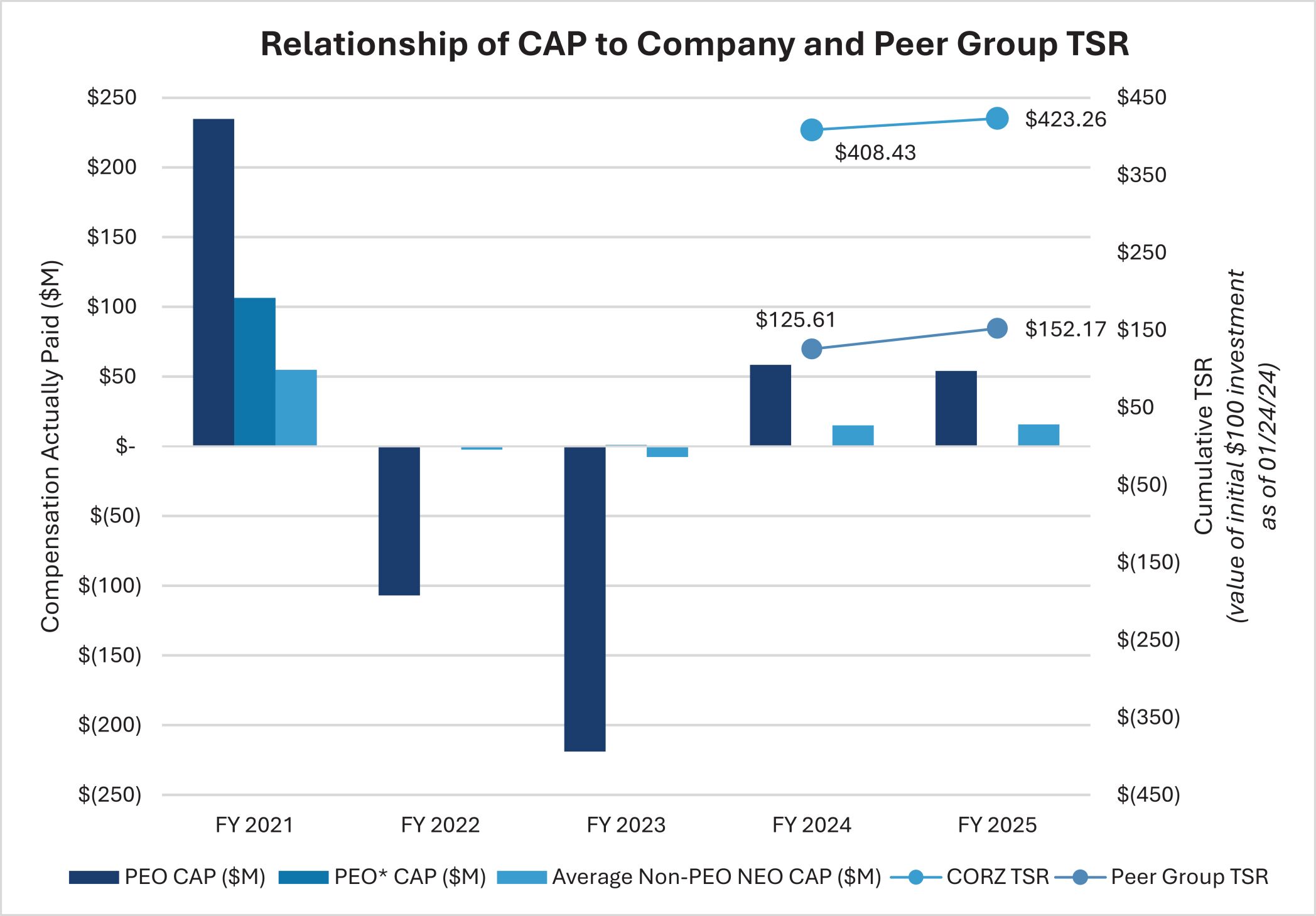
CORE SCIENTIFIC 2026 PROXY STATEMENT Pay Versus Performance |
| 57 |
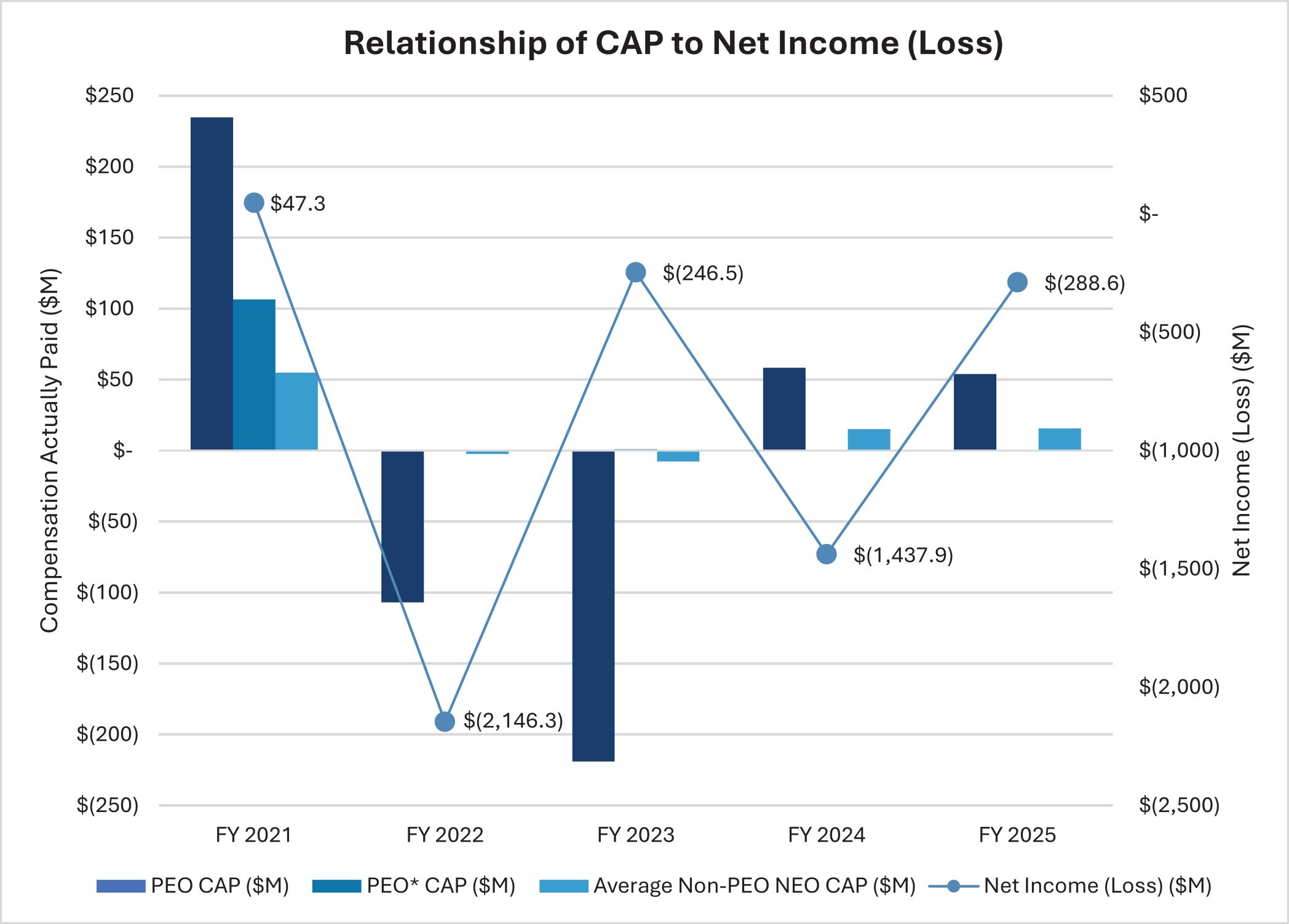
58 | |
CORE SCIENTIFIC 2026 PROXY STATEMENT Pay Versus Performance |
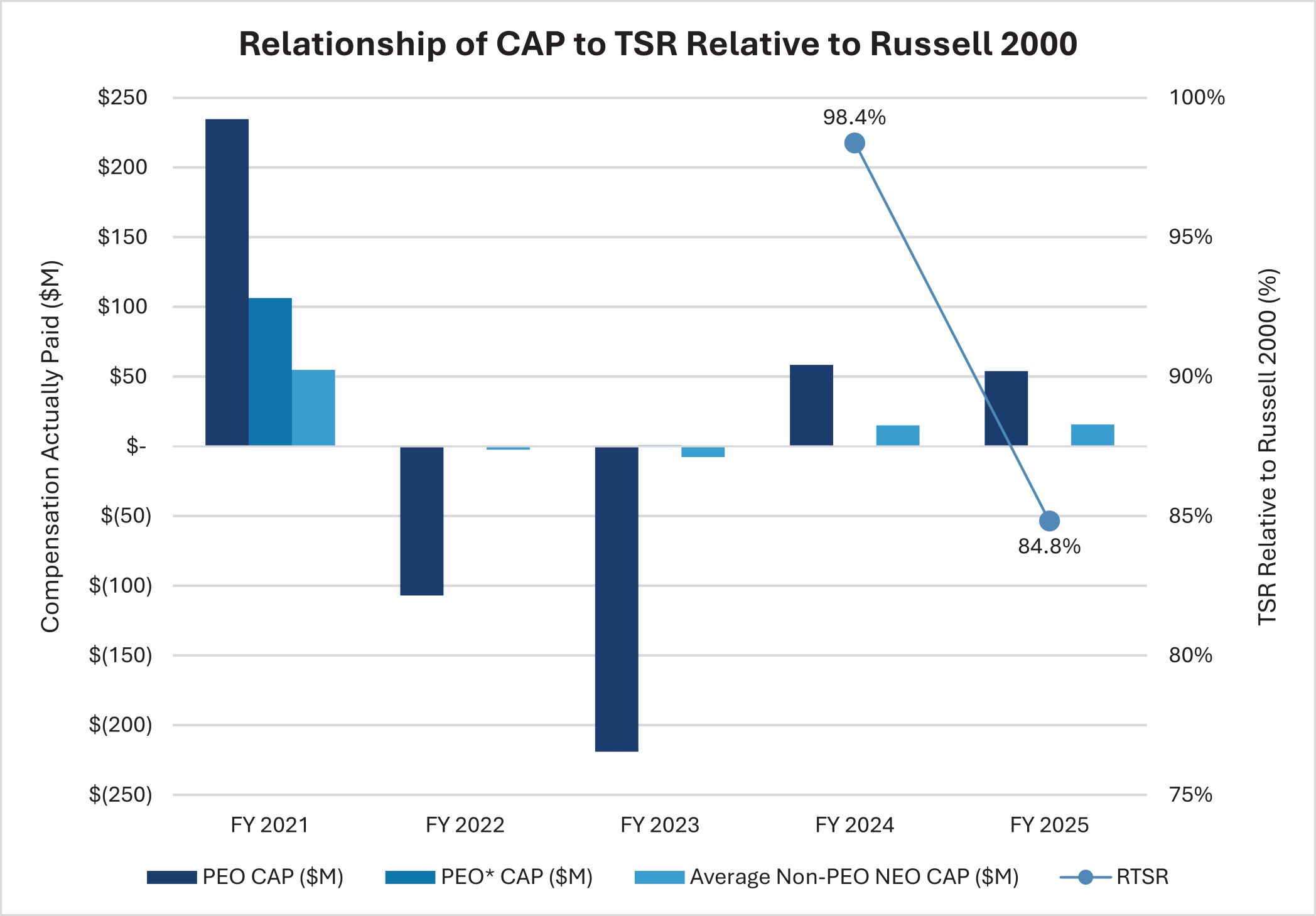
Table of Contents
| CORE SCIENTIFIC 2026 PROXY STATEMENT Non-Employee Director Compensation |
| 59 |
NON-EMPLOYEE DIRECTOR COMPENSATION
2025 Director Compensation Table
The following table provides information regarding compensation awarded to, earned by or paid to each of our non-employee directors during the fiscal year ended December 31, 2025. Mr. Sullivan, our Chief Executive Officer, is also a member of our board of directors, but does not receive any additional compensation for his service as director. See the section titled “Executive Compensation” for more information regarding the compensation earned by Mr. Sullivan for 2025.
| Name |
Fees Earned or Paid in Cash($) |
Stock Awards ($)(1)(2) |
Total($)(1) | |||||||||
| Jeff Booth |
67,849 | 334,120 | 401,969 | |||||||||
| Elizabeth Crain(3) |
76,563 | 500,003 | 576,566 | |||||||||
| Jordan Levy |
111,287 | 334,120 | 445,407 | |||||||||
| Yadin Rozov |
90,349 | 334,120 | 424,469 | |||||||||
| Eric Weiss |
67,849 | 334,120 | 401,969 | |||||||||
| Todd Becker(4) |
62,500 | — | 62,500 | |||||||||
| Jarrod Patten(5) |
92,500 | — | 92,500 | |||||||||
| (1) | Amounts reported represent the aggregate grant date fair value of the stock awards granted to our NEOs during the fiscal years presented, calculated in accordance with ASC Topic 718, excluding the effect of estimated forfeitures. The assumptions used in calculating the grant date fair value of the stock awards are set forth in Note 2 to our audited consolidated financial statements included in our Annual Report on Form 10-K for the fiscal year ended December 31, 2025. These amounts do not reflect the actual economic value that may be realized by the non-employee directors. |
| (2) | The aggregate number of shares outstanding underlying all stock awards held by our non-employee directors as of December 31, 2025 are set forth in the following table: |
| Name |
Number of Shares Underlying RSUs (#) |
|||
| Jeff Booth |
147,894 | |||
| Elizabeth Crain |
46,773 | |||
| Jordan Levy |
147,894 | |||
| Yadin Rozov |
147,894 | |||
| Eric Weiss |
147,894 | |||
| (3) | Ms. Crain was appointed to our Board of Directors in May 2025. |
| (4) | Mr. Becker resigned from our Board of Directors in May 2025. |
| (5) | Mr. Patten resigned from our Board of Directors upon the expiration of his term at the 2025 annual meeting of stockholders in May 2025. |
Non-Employee Director Compensation
For 2025, each non-employee director was eligible to receive an annual grant of RSUs having a fair market value of $300,000, vesting one-year from the date of grant provided the director remained in continuous services through the vesting date and an annual cash retainer for their service on our Board of Directors and board committees as follows:
| 1. | Annual Board Service Retainer: |
| a. | All Eligible Directors: $100,000 |
| b. | Chair of the Board: $75,000 |
| 2. | Annual Committee Chair Service Retainer: |
| a. | Chair of the Audit Committee: $25,000 |
| b. | Chair of the Compensation Committee: $25,000 |
| c. | Chair of the Nominating and Corporate Governance Committee: $10,000 |
Table of Contents
| 60 | | CORE SCIENTIFIC 2026 PROXY STATEMENT Non-Employee Director Compensation |
| 3. | Annual Committee Service Retainer: |
| a. | Member of the Audit Committee: $10,000 |
| b. | Member of the Compensation Committee: $7,500 |
| c. | Member of the Nominating and Corporate Governance Committee: $5,000 |
The annual cash compensation amounts are payable in equal quarterly installments in advance, pro-rated for any partial months of service.
For 2026, each non-employee director is eligible to receive an annual grant of RSUs having a fair market value of $300,000, vesting one-year from the date of grant provided the director remains in continuous service through the vesting date and an annual cash retainer for their service on our Board of Directors and board committees as follows:
| 1. | Annual Board Service Retainer: |
| a. | All Eligible Directors: $125,000 |
| b. | Chair of the Board: $100,000 |
| 2. | Annual Committee Chair Service Retainer: |
| a. | Chair of the Audit Committee: $35,000 |
| b. | Chair of the Compensation Committee: $25,000 |
| c. | Chair of the Nominating and Corporate Governance Committee: $25,000 |
| 3. | Annual Committee Service Retainer: |
| a. | Member of the Audit Committee: $25,000 |
| b. | Member of the Compensation Committee: $20,000 |
| c. | Member of the Nominating and Corporate Governance Committee: $20,000 |
In addition to the above retainer, newly elected members of the Board of Directors will receive a one-time grant of $500,000 in restricted stock units, vesting ratably over two years from the date of grant provided the director remains in continuous service through the vesting date.
Table of Contents
| CORE SCIENTIFIC 2026 PROXY STATEMENT Securities Authorized for Issuance Under Equity Compensation Plans |
| 61 |
SECURITIES AUTHORIZED FOR ISSUANCE UNDER EQUITY COMPENSATION PLANS
The following table provides certain information with respect to all equity compensation plans in effect as of December 31, 2025:
| Plan Category |
(a) Number of securities to be issued upon exercise of outstanding options, warrants and rights |
(b) Weighted- average exercise price of outstanding options, warrants and rights(3) |
(c) Number of securities remaining available for issuance under equity compensation plans (excluding securities reflected in column (a)) |
|||||||||
| Legacy equity compensation plans approved by security holders(1) |
541,013 | $ | 54.78 | — | ||||||||
| Current equity compensation plans approved by security holders(2) |
17,236,734 | — | 19,996,154 | |||||||||
| Total |
NA | |||||||||||
| (1) | Includes (i) the Core Scientific, Inc. (f/k/a MineCo Holdings, Inc.) 2018 Omnibus Incentive Plan, (ii) the Blockcap, Inc. Equity Incentive Plan, (iii) the Amended and Restated 2018 Equity Incentive Plan, and (iv) the Core Scientific 2021 Equity Incentive Plan (collectively, the “Legacy Equity Plans”). Following the adoption of the 2024 Stock Plan, the Legacy Equity Plans were terminated, and no additional equity incentive awards may be issued pursuant to the Legacy Equity Plans. As of December 31, 2025, there were 196,967 restricted stock units and 344,076 stock options outstanding under the Legacy Equity Plans. |
| (2) | The 2024 Stock Plan, was approved by the Bankruptcy Court in connection with the Plan of Reorganization and as amended by the Company’s stockholders, authorizes the issuance of compensatory awards of not more than 48,000,000 shares of our common stock. |
| (3) | This column excludes any outstanding RSUs, which have no exercise price. |
Table of Contents
| 62 | | CORE SCIENTIFIC 2026 PROXY STATEMENT Proposal 3: Ratification of Selection of Independent Registered Public Accounting Firm |
PROPOSAL 3
RATIFICATION OF SELECTION OF INDEPENDENT REGISTERED PUBLIC ACCOUNTING FIRM
The Audit Committee of the Board of Directors has selected KPMG LLP (“KPMG” or “Auditor”) as our independent registered public accounting firm for the fiscal year ending December 31, 2026, and has further directed that management submit the selection of KPMG for ratification by the stockholders at the Annual Meeting. KPMG has been engaged by us since March 12, 2025. Representatives of KPMG are expected to be present at the Annual Meeting. They will have an opportunity to make a statement if they so desire and will be available to respond to appropriate questions.
Neither our bylaws nor other governing documents or law require stockholder ratification of the selection of KPMG as our independent registered public accounting firm. However, the Audit Committee of the Board of Directors is submitting the selection of KPMG to the stockholders for ratification as a matter of good corporate practice. If the stockholders fail to ratify the selection, the Audit Committee will reconsider whether or not to retain that firm. Even if the selection is ratified, the Audit Committee in its discretion may direct the appointment of different independent auditors at any time during the year if they determine that such a change would be in the best interest of the Company and our stockholders.
Change in Independent Registered Public Accounting Firm
On March 12, 2025, the Audit Committee approved the dismissal of Marcum LLP (“Marcum”) as our independent registered public accounting firm. Management communicated the Audit Committee’s decision to Marcum on that date.
Marcum’s audit report on our consolidated financial statements as of December 31, 2024, and 2023 and for each of the three years in the period ended on December 31, 2024, dated February 26, 2025, did not contain any adverse opinion or disclaimer of opinion, and were not qualified or modified as to uncertainties, audit scope or accounting principles.
During the years ended December 31, 2023 and 2024 and the subsequent interim period through March 12, 2025, there were (i) no “disagreements” (as such term is defined in Item 304(a)(1)(iv) of Regulation S-K) with Marcum on any matter of accounting principles or practices, financial statement disclosure, or auditing scope or procedures, which disagreements, if not resolved to the satisfaction of Marcum, would have caused Marcum to make reference thereto in its reports on the Company’s financial statements for such periods, and (ii) no “reportable events” (as such term is defined in Item 304(a)(1)(v) of Regulation S-K).
We provided Marcum with a copy of the disclosures regarding the dismissal contained in our Current Report on Form 8-K filed with the SEC on March 13, 2025 (the “Current Report”) and received a letter from Marcum addressed to the SEC stating that it agreed with the statements contained in the Current Report. This letter was filed as Exhibit 16.1 to the Current Report.
On March 12, 2025, the Audit Committee approved the engagement of KPMG as our independent registered public accounting firm for the fiscal year ended December 31, 2025, effective March 12, 2025. During the year ended December 31, 2024 and the subsequent interim period through March 12, 2025, neither the Company nor anyone on behalf of the Company consulted with KPMG regarding (i) the application of accounting principles to a specified transaction (either completed or proposed), or the type of audit opinion that might be rendered on the financial statements of the Company or (ii) any matter that was either the subject of a “disagreement,” as defined in Item 304(a)(1)(iv) of Regulation S-K, or a “reportable event,” as defined in Item 304(a)(1)(v) of Regulation S-K.
Principal Accountant Fees and Services
The following table represents aggregate fees billed to the Company for the fiscal year ended December 31, 2025 by KPMG (in thousands):
| Year Ended December 31, 2025 | ||||
| Audit Fees(1) |
$ | 2,650 | ||
| Audit-Related Fees |
— | |||
| Tax Fees |
— | |||
| All Other Fees |
— | |||
| Total Fees |
$ | 2,650 | ||
| (1) | “Audit Fees” consist of fees in connection with the audit of our annual consolidated financial statements, including the audited financial statements presented in our Annual Report on Form 10-K, and services that are normally provided in connection with statutory and regulatory filings or engagements for those fiscal years. |
Table of Contents
| CORE SCIENTIFIC 2026 PROXY STATEMENT Proposal 3: Ratification of Selection of Independent Registered Public Accounting Firm |
| 63 |
Prior Principal Accountant Fees and Services
The following table represents aggregate fees billed to the Company for the fiscal years ended December 31, 2025 and 2024 by Marcum (in thousands). Following the dismissal of Marcum as our independent registered public accounting firm on March 12, 2025, no services were provided to us by Marcum, other than comfort letters and other services related to Marcum’s audit of the 2024 financial statements.
| Year Ended December 31, | ||||||||
| 2025 | 2024 | |||||||
| Audit Fees(1) |
$ | 169 | $ | 1,863 | ||||
| Audit-Related Fees |
— | — | ||||||
| Tax Fees |
— | — | ||||||
| All Other Fees |
— | — | ||||||
| Total Fees |
$ | 169 | $ | 1,863 | ||||
| (1) | “Audit Fees” for 2024 consist of fees in connection with the audit of our annual consolidated financial statements, including the audited financial statements presented in our Annual Report on Form 10-K, and services that are normally provided in connection with statutory and regulatory filings or engagements for those fiscal years. Audit Fees for 2025 relate to comfort letters and other services related to Marcum’s audit of the 2024 financial statements. |
All fees described above were pre-approved by the Audit Committee. There were no services that were approved by the Audit Committee pursuant to Rule 2-01(c)(7)(i)(C) (relating to the approval of a de minimis amount of non-audit services after the fact but before completion of the audit).
Pre-Approval Policies and Procedures
The Audit Committee has adopted a policy and procedures for the pre-approval of audit and non-audit services rendered by the Company’s independent registered public accounting firm. The policy generally pre-approves specified services in the defined categories of audit services, audit-related services and tax services and permissible non-audit services subject to a de minimis exception. Pre-approval may also be given as part of the Audit Committee’s approval of the scope of the engagement of the independent auditor or on an individual, explicit, case-by-case basis before the independent auditor is engaged to provide each service. The pre-approval of services may be delegated to one or more of the Audit Committee’s members, but the decision must be reported to the full Audit Committee at its next scheduled meeting.
| Recommendation of the Board of Directors |
||||||||
| The Board of Directors recommends voting “FOR” the ratification of the appointment of KPMG LLP as our independent registered public accounting firm for the year ending December 31, 2026.
|
||||||||
Table of Contents
| 64 | | CORE SCIENTIFIC 2026 PROXY STATEMENT Security Ownership of Certain Beneficial Owners and Management |
SECURITY OWNERSHIP OF CERTAIN BENEFICIAL OWNERS AND MANAGEMENT
The following table sets forth certain information regarding the ownership of the Company’s common stock as of March 23, 2026 by: (i) each director and nominee for director; (ii) each of our named executive officers; (iii) all current executive officers and directors of the Company as a group; and (iv) all those known by the Company to be beneficial owners of more than five percent of its common stock.
We have determined beneficial ownership in accordance with the rules and regulations of the SEC, and the information is not necessarily indicative of beneficial ownership for any other purpose. Except as indicated by the footnotes below, we believe, based on information furnished to us, that the persons and entities named in the table below have sole voting and sole investment power with respect to all shares that they beneficially own, subject to applicable community property laws.
Applicable percentages are based on 315,594,802 shares of common stock outstanding on March 23, 2026 and does not include 96,666,014 tranche 1 warrants and 7,766,619 tranche 2 warrants outstanding on that date. In computing the number of shares beneficially owned by a person and the percentage ownership of such person, we deemed to be outstanding all shares of common stock issuable upon the exercise of tranche 1 warrants and tranche 2 warrants held by such person and shares subject to RSUs held by such person that would vest based on service-based vesting conditions within 60 days of March 23, 2026. Except as described above, we did not deem such shares outstanding for the purpose of computing the percentage ownership of any other person.
Unless otherwise noted below, the address of each stockholder below is c/o Core Scientific, Inc., 838 Walker Road, Suite 21-2105, Dover, Delaware 19904.
| Beneficial Ownership of Common Stock |
||||||||
| Name of Beneficial Owner |
Number of Shares(1) |
Percent of Class |
||||||
| Directors and Named Executive Officers: |
||||||||
| Adam Sullivan(2) |
2,525,143 | * | ||||||
| Todd M. DuChene(3) |
1,844,855 | * | ||||||
| James Nygaard(4) |
608,562 | * | ||||||
| Jeff Booth(5) |
68,241 | * | ||||||
| Elizabeth Crain |
— | * | ||||||
| Jordan Levy(6) |
179,441 | * | ||||||
| Yadin Rozov(7) |
118,241 | * | ||||||
| Eric Weiss(8) |
106,241 | * | ||||||
| Denise Sterling(9) |
594,833 | * | ||||||
| All current directors and executive officers as a group (8 individuals) |
5,450,724 | 1.7 | % | |||||
| 5% Stockholders |
||||||||
| The Vanguard Group(10) |
33,960,320 | 10.8 | % | |||||
| Situational Awareness(11) |
28,756,478 | 9.1 | % | |||||
| Pentwater Capital Management LP(12) |
26,050,000 | 8.3 | % | |||||
| BlackRock, Inc.(13) |
23,299,564 | 7.4 | % | |||||
| Two Seas Capital(14) |
17,466,669 | 5.5 | % | |||||
| Susquehanna Securities(15) |
17,376,097 | 5.5 | % | |||||
| Citadel Securities(16) |
17,185,727 | 5.4 | % | |||||
| * | Less the 1% |
| (1) | This table is based on information supplied by officers and directors and principal stockholders and Schedules 13D and 13G and Forms 3 and 4 filed with the SEC. Unless otherwise indicated in the footnotes to this table and subject to community property laws where applicable, the |
Table of Contents
| CORE SCIENTIFIC 2026 PROXY STATEMENT Security Ownership of Certain Beneficial Owners and Management |
| 65 |
| Company believes that each of the stockholders named in the table has sole voting and investment power with respect to the shares indicated as beneficially owned. |
| (2) | Represents (i) 1,669,234 shares of common stock, (ii) 114,364 shares of common stock issuable upon the exercise of tranche 1 warrants and (iii) 741,545 shares of common stock issuable within 60 days of March 23, 2026, in each case held by Mr. Sullivan. |
| (3) | Represents (i) 1,110,988 shares of common stock, (ii) 517,133 shares of common stock issuable upon the exercise of tranche 1 warrants and (iii) 216,734 shares of common stock issuable within 60 days of March 23, 2026, in each case held by Mr. DuChene. |
| (4) | Represents (i) 475,205 shares of common stock and (ii) 133,357 shares of common stock issuable upon exercise of tranche 1 warrants held by Mr. Nygaard. |
| (5) | Represents 68,241 shares of common stock owned by Mr. Booth. |
| (6) | Represents 179,441 shares of common stock owned by Mr. Levy. |
| (7) | Represents (i) 88,241 shares of common stock and (ii) 30,000 shares of common stock issuable upon exercise of tranche 1 warrants, in each case held by Mr. Rozov. |
| (8) | Represents 106,241 shares of common stock owned by Mr. Weiss. |
| (9) | Represents (i) 368,058 shares of common stock, (ii) 123,696 shares of common stock issuable upon the exercise of tranche 1 warrants and (iii) 103,080 shares of common stock issuable upon the exercise of tranche 2 warrants, in each case held by Ms. Sterling. Ms. Sterling resigned as our Executive Vice President, Chief Financial Officer, effective March 17, 2025, and terminated service as an employee on January 16, 2026. She is included in this table because she is a named executive officer for the year ended December 31, 2025, but she is not counted for purposes of aggregating beneficial ownership of directors and executive officers as a group. |
| (10) | Based on a Schedule 13G/A filed with the SEC by The Vanguard Group on January 7, 2026. Of the shares of common stock beneficially owned, The Vanguard Group reported that it has shared voting power with respect to 2,133,911 shares, sole dispositive power with respect to 31,476,399 shares and shared dispositive power with respect to 2,483,921 shares. The Vanguard Group listed its principal place of business as 100 Vanguard Blvd., Malvern, PA 19355. |
| (11) | Based on a Schedule 13D/A filed with the SEC by Situational Awareness LP and certain affiliated entities and persons on October 14, 2025. Of the shares of common stock beneficially owned, each of Situational Awareness LP, SAF AI GP LP, Situational Awareness LLC, Situational Awareness Partners LP, Leopold Aschenbrenner and Carl Shulman reported that it or he has shared voting power with respect to 28,756,478 shares and shared dispositive power with respect to 28,756,478 shares. Situational Awareness LP is an investment adviser to Situational Awareness Partners LP. SAF AI GP LP is the general partner of Situational Awareness Partners LP. SA LLC is the general partner of Situational Awareness LP. Mr. Aschenbrenner is the managing partner and control person of Situational Awareness LP and SAF AI GP LP and the manager of SA LLC. Mr. Shulman is the co-portfolio manager of Situational Awareness Partners LP. The foregoing entities and persons list their principal place of business as 512 Second Street, Suite 400, San Francisco, CA 94107. |
| (12) | Based on a Schedule 13G filed with the SEC by Pentwater Capital Management LP on November 14, 2025. Of the shares of common stock beneficially owned, each of Pentwater Capital Management LP and Matthew Halbower reported that it or he has shared voting power with respect to 26,050,000 shares and shared dispositive power with respect to 26,050,000 shares. Mr. Halbower is the sole shareholder of MCH PWCM Holdings Inc., the general partner of Pentwater Capital Management LP. Each of Pentwater Capital Management LP and Mr. Halbower list their principal place of business as 1001 10th Avenue South, Suite 216, Naples, FL 34102. |
| (13) | Based on a Schedule 13G/A filed with the SEC by Blackrock, Inc. on July 16, 2025. Of the shares of common stock beneficially owned, Blackrock reported that it has sole voting power with respect to 22,773,781 shares and sole dispositive power with respect to 23,299,564 shares. Blackrock, Inc. listed its principal place of business as 50 Hudson Yards, New York, New York 10001. |
| (14) | Based on a Schedule 13D/A filed with the SEC by Two Seas Capital LP on March 20, 2026. Of the shares of common stock beneficially owned, each of Two Seas Capital LP, Two Seas Capital GP LLC and Sina Toussi reported that it or he has sole voting power with respect to 17,466,679 shares and sole dispositive power with respect to 17,466,679 shares. Two Seas Capital LP provides investment advice as a registered investment adviser serving as investment manager to certain investment funds and managed accounts. Two Season Capital GP LLC serves as general partner of Two Seas Capital LP and Mr. Toussi serves as the Chief Investment Officer of Two Seas Capital LP and Managing Member of Two Season Capital GP LLC. The foregoing entities and person list their principal place of business as 32 Elm Place, 3rd Floor, Rye, NY 10580. |
| (15) | Based on a Schedule 13G filed with the SEC by Susquehanna Securities, LLC and certain affiliated entities on February 12, 2026. Of the shares of common stock beneficially owned, (i) Susquehanna Securities, LLC reported that it has sole voting power with respect to 16,618,391 shares, shared voting power with respect to 17,376,097 shares, sole dispositive power with respect to 16,618,391 shares and shared dispositive power with respect to 17,376,097 shares; (ii) G1 Execution Services, LLC reported that it has sole voting power with respect to 5,805 shares, shared voting power with respect to 17,376,097 shares, sole dispositive power with respect to 5,805 shares and shared dispositive power with respect to 17,376,097 shares; (iii) SIG Brokerage, LP reported that it has sole voting power with respect to 300,000 shares, shared voting power with respect to 17,376,097 shares, sole dispositive power with respect to 300,000 shares and shared dispositive power with respect to 17,376,097 shares; and (iv) Susquehanna Investment Group reported that it has sole voting power with respect to 451,901 shares, shared voting power with respect to 17,376,097 shares, sole dispositive power with respect to 451,901 shares and shared dispositive power with respect to 17,376,097 shares. Susquehanna Securities, LLC, G1 Execution Services, LLC, SIG Brokerage, LP and Susquehanna Investment Group are affiliated independent broker-dealers which may be deemed a group. G1 Execution Services, LLC lists its principal place of business as 175 W. Jackson Blvd., Suite 1700, Chicago, IL 60604, and each of Susquehanna Securities, LLC, SIG Brokerage, LP and Susquehanna Investment Group list its principal place of business as 401 E. City Avenue, Suite 220, Bala Cynwyd, PA 19004. |
| (16) | Based on a Schedule 13G filed with the SEC by Citadel Securities GP LLC and certain affiliated entities and persons on December 10, 2025. Of the shares of common stock beneficially owned, (i) each of Citadel Securities GP LLC, Citadel Securities Group LP and Kenneth Griffin reported that it has shared voting power with respect to 17,185,727 shares and shared dispositive power with respect to 17,185,727 shares; and (ii) Citadel Securities LLC reported that it has shared voting power with respect to 14,020,517 shares and shared dispositive power with respect to 14,020,517 shares. Citadel Securities Group LP is the non-member manager of Citadel Securities LLC, CRBU Holdings LLC and Citadel Securities Principal Strategies LLC. Citadel Securities GP LLC is the general partner of Citadel Securities Group LP. Citadel Advisors Holdings LP is the sole member of Citadel Advisors. Citadel GP LLC is the general partner of Citadel Advisors Holdings LP. Mr. Griffin is the President and Chief Executive Officer of Citadel GP LLC and owns a controlling interest in Citadel GP LLC and Citadel Securities GP LLC. The foregoing entities and persons list their principal place of business as 830 Brickell Plaza, Miami, Florida 33131. |
Table of Contents
| 66 | | CORE SCIENTIFIC 2026 PROXY STATEMENT Transactions with Related Persons |
TRANSACTIONS WITH RELATED PERSONS
There were no transactions with related persons since January 1, 2025. The Company’s Corporate Governance Principles adopted by the Board of Directors provide that neither the Company nor any individual shall enter into a related party transaction unless it has been reviewed and approved or ratified by the Audit Committee. A “related party transaction” for these purposes is defined as a transaction for which disclosure would be required pursuant to Item 404 of Regulation S-K.
Indemnification Agreements
Our certificate of incorporation contains provisions limiting the liability of executive officers and directors, and our bylaws provide that we will indemnify each of our executive officers and directors to the fullest extent permitted under Delaware law.
We have entered into indemnification agreements with all of our directors and executive officers. The indemnification agreements provide that we will indemnify each of our directors, executive officers, and other key employees against any and all expenses incurred by such director, executive officer, or other key employee because of his or her status as one of our directors, executive officers, or other key employees, to the fullest extent permitted by Delaware law, our certificate of incorporation and our bylaws. In addition, the indemnification agreements provide that, to the fullest extent permitted by Delaware law, we will advance all expenses incurred by its directors, executive officers, and other key employees in connection with a legal proceeding involving his or her status as a director, executive officer, or key employee.
Other Related Party Transactions
We have entered into employment agreements with our named executive officers. For more information regarding employment agreements with our named executive officers, see the section titled “Executive Compensation — Employment Agreements with Named Executive Officers.”
We have also granted restricted stock units to our named executive officers and directors. For a description of these equity awards, see the section titled “Executive Compensation.”
Related Person Transaction Policy
We have adopted a written related person transactions policy that sets forth our policies and procedures regarding the identification, review, consideration, and oversight of “related person transactions.” For purposes of the policy only, a “related person transaction” is a transaction, arrangement, or relationship (or any series of similar transactions, arrangements or relationships) in which we or any of our subsidiaries are participants involving an amount that exceeds $120,000, in which any “related person” has a material interest.
Transactions involving compensation for services provided to us as an employee, consultant or director will not be considered related person transactions under this policy. A related person is any officer, director, nominee to become a director, employee, or a holder of more than 5% of any class of our voting securities (including the common stock), including any of their immediate family members and affiliates, including entities owned or controlled by such persons.
Under the policy, the related person in question or, in the case of transactions with a holder of more than 5% of any class of our voting securities, an officer with knowledge of a proposed transaction, must present information regarding the proposed related person transaction to the Audit Committee (or, where review by the Audit Committee would be inappropriate, to another independent body of the Board of Directors) for review. To identify related person transactions in advance, we will rely on information supplied by our officers, directors, and certain significant stockholders. In considering related person transactions, the Audit Committee will take into account the relevant available facts and circumstances, which may include, but are not limited to:
| • | the risks, costs, and benefits to us; |
| • | the impact on a director’s independence in the event the related person is a director, immediate family member of a director or an entity with which a director is affiliated; |
| • | the terms of the transaction; |
| • | the availability of other sources for comparable services or products; and |
| • | the terms available to or from, as the case may be, unrelated third parties. |
The Audit Committee will approve only those transactions that it determines are fair to us and in our best interests.
Table of Contents
| CORE SCIENTIFIC 2026 PROXY STATEMENT Stockholder Proposals for the 2026 Annual Meeting |
| 67 |
STOCKHOLDER PROPOSALS FOR THE 2027 ANNUAL MEETING
Stockholders of the Company may submit proposals that they believe should be voted upon at the Company’s annual meeting of stockholders or nominate persons for election to the Board of Directors.
Pursuant to Rule 14a-8 under the Exchange Act, stockholder proposals meeting certain requirements may be eligible for inclusion in the Company’s proxy statement for the Company’s 2027 Annual Meeting of Stockholders. To be eligible for inclusion in the Company’s 2027 proxy statement, any such stockholder proposal must be submitted in writing to the Company’s Corporate Secretary at the principal executive offices of the Company, no later than December 1, 2026, in addition to complying with certain rules and regulations promulgated by the SEC. The submission of a stockholder proposal does not guarantee that it will be included in the Company’s proxy statement.
Alternatively, in accordance with the “advance notice” provisions of our bylaws, stockholders seeking to present a stockholder proposal or nomination at the Company’s 2027 Annual Meeting of Stockholders, without having it included in the Company’s proxy statement, must timely submit notice of such proposal or nomination. To be timely, a stockholder’s notice must be received by the Company’s Corporate Secretary at the principal executive offices of the Company not later than the close of business on the 90th day nor earlier than the close of business on the 120th day before the first anniversary of the 2026 Annual Meeting of Stockholders, unless the date of the 2027 Annual Meeting of Stockholders is advanced by more than 30 days or delayed by more than 30 days from the anniversary of the 2026 Annual Meeting of Stockholders. For the Company’s 2027 Annual Meeting of Stockholders, this means that any such proposal or nomination must be submitted no earlier than January 12, 2027 and no later than February 11, 2027. If the date of the 2027 Annual Meeting of Stockholders is advanced by more than 30 days or delayed by more than 30 days from the anniversary of the 2026 Annual Meeting of Stockholders, the stockholder must submit any such proposal or nomination no earlier than the close of business on the 120th day prior to the 2027 Annual Meeting of Stockholders and not later than the close of business on the later of the 90th day prior to the 2027 Annual Meeting of Stockholders or the 10th day following the day on which public announcement of the date of the 2027 Annual Meeting of Stockholders is first made by the Company.
In addition to satisfying the deadlines in the “advance notice” provisions of our bylaws, a stockholder who intends to solicit proxies in support of nominees submitted under these “advance notice” provisions, to comply with the universal proxy rules, must include in their notice the information required by Rule 14a-19 under the Exchange Act.
Notice of any proposals or nominations for the Company’s 2027 Annual Meeting of Stockholders should be sent to our Corporate Secretary at c/o Core Scientific, Inc., 838 Walker Road, Suite 21-2105, Dover, Delaware 19904.
Table of Contents
| 68 | | CORE SCIENTIFIC 2026 PROXY STATEMENT Householding of Proxy Materials |
HOUSEHOLDING OF PROXY MATERIALS
The SEC has adopted rules that permit companies and intermediaries (e.g., brokers) to satisfy the delivery requirements for Annual Meeting materials with respect to two or more stockholders sharing the same address by delivering a single set of Annual Meeting materials addressed to those stockholders. This process, which is commonly referred to as “householding,” potentially means extra convenience for stockholders and cost savings for companies.
This year, a number of brokers with account holders who are Core Scientific, Inc. stockholders will be “householding” the Company’s proxy materials. A single set of Annual Meeting materials will be delivered to multiple stockholders sharing an address unless contrary instructions have been received from the affected stockholders. Once you have received notice from your broker that they will be “householding” communications to your address, “householding” will continue until you are notified otherwise or until you revoke your consent. If, at any time, you no longer wish to participate in “householding” and would prefer to receive a separate set of Annual Meeting materials, please notify your broker or Core Scientific, Inc. Direct your written request to 838 Walker Road, Suite 21-2105, Dover, Delaware 19904, Attn: Secretary, or contact the Secretary at (425) 998-5300. Stockholders who currently receive multiple copies of the Annual Meeting materials at their addresses and would like to request “householding” of their communications should contact their brokers.
Table of Contents
| CORE SCIENTIFIC 2026 PROXY STATEMENT Other Matters |
| 69 |
OTHER MATTERS
The Board of Directors knows of no other matters that will be presented for consideration at the Annual Meeting. If any other matters are properly brought before the Annual Meeting, it is the intention of the persons named in the accompanying proxy to vote on such matters in accordance with their best judgment.
By Order of the Board of Directors,
Todd M. DuChene
Chief Legal and Administrative Officer and Secretary
March 31, 2026
A copy of the Company’s Annual Report to the Securities and Exchange Commission on Form 10-K for the fiscal year ended December 31, 2025, is available without charge upon written request to: Secretary, Core Scientific, Inc. 838 Walker Road, Suite 21-2105, Dover, Delaware 19904.
Table of Contents
| CORE SCIENTIFIC 2026 PROXY STATEMENT Appendix A |
| A-1 |
APPENDIX A
Non-GAAP Financial Measures
This Proxy Statement includes controllable expenses, which is a non-GAAP financial measure that is a supplemental measure of the Company’s performance. This non-GAAP financial measure excludes certain items that management considers to be either outside of management’s direct control, non-cash in nature, or not reflective of the Company’s ongoing cost management performance. Our management team utilizes a combination of GAAP and non-GAAP financial measures to evaluate business results, to make decisions regarding the future direction of the business, and for resource allocation decisions, including incentive compensation. Management uses controllable expenses to evaluate the effectiveness of cost management across the organization and as a performance metric for the Company’s annual cash incentive compensation program. As a result, we believe the presentation of both GAAP and non-GAAP financial measures provides investors with increased transparency into financial measures used by the management team and improves investors’ understanding of the Company’s underlying operating performance.
Because non-GAAP financial measures are not standardized, they may not be comparable to financial measures used by other companies or to non-GAAP financial measures having the same or similar names. In order to compensate for such limitations of non-GAAP measures, readers should review the reconciliation below and should not consider this measure in isolation from, or as an alternative to, the comparable financial measures determined in accordance with GAAP.
Controllable expenses: The Company defines controllable expenses as total costs and expenses for the calendar year, excluding power fees, depreciation and amortization, stock-based compensation expense, cash incentive bonuses, advisor fees, non-controllable legal expenses, and certain non-cash and non-recurring items as described below. The most directly comparable GAAP financial measure is total costs and expenses.
The following table presents a reconciliation of total costs and expenses to controllable expenses for the year ended December 31, 2025 (in thousands):
| Year Ended December 31, 2025 |
||||
| Total costs and expenses: |
||||
| Cost of revenue |
281,121 | |||
| Operating expenses |
283,487 | |||
| Total costs and expenses |
$ | 564,608 | ||
| Adjustments: |
||||
| Decrease in fair value of digital assets |
(31,603 | ) | ||
| Loss on disposal of property, plant and equipment |
(9,680 | ) | ||
| Impairment of property, plant and equipment |
(11,359 | ) | ||
| Power fees |
(155,323 | ) | ||
| Depreciation and amortization |
(68,841 | ) | ||
| Stock-based compensation expense |
(98,236 | ) | ||
| Cash incentive bonuses |
(24,258 | ) | ||
| Advisor fees |
(23,372 | ) | ||
| Non-controllable legal expenses |
(7,301 | ) | ||
| Total adjustments |
$ | (429,973 | ) | |
| Controllable Expenses |
$ | 134,635 | ||
Cost of revenue and operating expenses are components of total costs and expenses as reported in the Company’s Consolidated Statements of Operations included in the Annual Report on Form 10-K for the year ended December 31, 2025. Operating expenses consist of the decrease in fair value of digital assets, loss on disposal of property, plant and equipment, impairment of property, plant and equipment, colocation organizational and site startup costs, advisor fees, and selling, general and administrative expenses.
Table of Contents
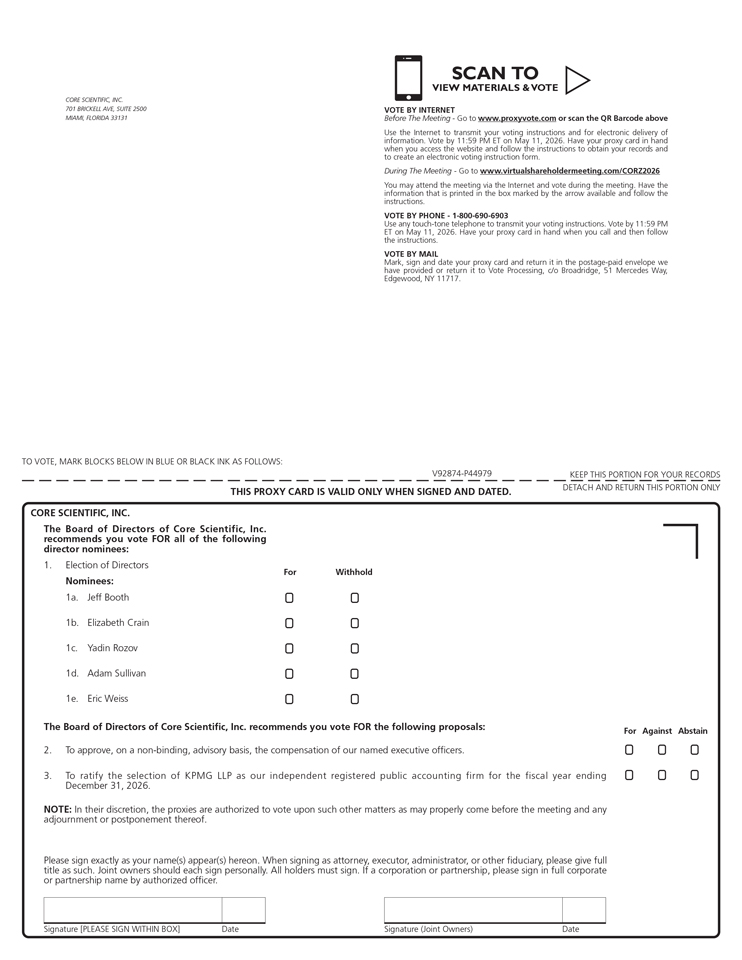
SCAN TO VIEW MATERIALS & VOTE CORE SCIENTIFIC, INC. 701 BRICKELL AVE, SUITE 2500 VOTE BY INTERNET MIAMI, FLORIDA 33131 Before The Meeting - Go to www.proxyvote.com or scan the QR Barcode above Use the Internet to transmit your voting instructions and for electronic delivery of information. Vote by 11:59 PM ET on May 11, 2026. Have your proxy card in hand when you access the website and follow the instructions to obtain your records and to create an electronic voting instruction form. During The Meeting - Go to www.virtualshareholdermeeting.com/CORZ2026 You may attend the meeting via the Internet and vote during the meeting. Have the information that is printed in the box marked by the arrow available and follow the instructions. VOTE BY PHONE - 1-800-690-6903 Use any touch-tone telephone to transmit your voting instructions. Vote by 11:59 PM ET on May 11, 2026. Have your proxy card in hand when you call and then follow the instructions. VOTE BY MAIL Mark, sign and date your proxy card and return it in the postage-paid envelope we have provided or return it to Vote Processing, c/o Broadridge, 51 Mercedes Way, Edgewood, NY 11717. TO VOTE, MARK BLOCKS BELOW IN BLUE OR BLACK INK AS FOLLOWS: V92874-P44979 KEEP THIS PORTION FOR YOUR RECORDS THIS PROXY CARD IS VALID ONLY WHEN SIGNED AND DATED. DETACH AND RETURN THIS PORTION ONLY CORE SCIENTIFIC, INC. The Board of Directors of Core Scientific, Inc. recommends you vote FOR all of the following director nominees: 1. Election of Directors Nominees: For Withhold 1a. Jeff Booth 1b. Elizabeth Crain 1c. Yadin Rozov 1d. Adam Sullivan 1e. Eric Weiss The Board of Directors of Core Scientific, Inc. recommends you vote FOR the following proposals: For Against Abstain 2. To approve, on a non-binding, advisory basis, the compensation of our named executive officers. 3. To ratify the selection of KPMG LLP as our independent registered public accounting firm for the fiscal year ending December 31, 2026. NOTE: In their discretion, the proxies are authorized to vote upon such other matters as may properly come before the meeting and any adjournment or postponement thereof. Please sign exactly as your name(s) appear(s) hereon. When signing as attorney, executor, administrator, or other fiduciary, please give full title as such. Joint owners should each sign personally. All holders must sign. If a corporation or partnership, please sign in full corporate or partnership name by authorized officer. Signature [PLEASE SIGN WITHIN BOX] Date Signature (Joint Owners) Date
Table of Contents
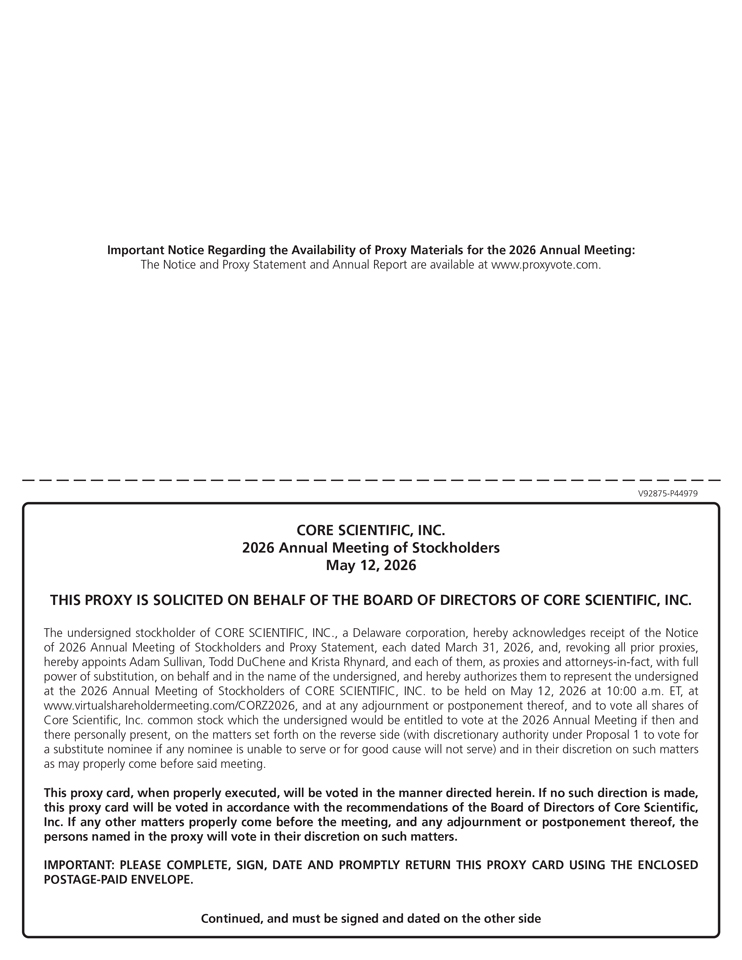
Important Notice Regarding the Availability of Proxy Materials for the 2026 Annual Meeting: The Notice and Proxy Statement and Annual Report are available at www.proxyvote.com. V92875-P44979 CORE SCIENTIFIC, INC. 2026 Annual Meeting of Stockholders May 12, 2026 THIS PROXY IS SOLICITED ON BEHALF OF THE BOARD OF DIRECTORS OF CORE SCIENTIFIC, INC. The undersigned stockholder of CORE SCIENTIFIC, INC., a Delaware corporation, hereby acknowledges receipt of the Notice of 2026 Annual Meeting of Stockholders and Proxy Statement, each dated March 31, 2026, and, revoking all prior proxies, hereby appoints Adam Sullivan, Todd DuChene and Krista Rhynard, and each of them, as proxies and attorneys-in-fact, with full power of substitution, on behalf and in the name of the undersigned, and hereby authorizes them to represent the undersigned at the 2026 Annual Meeting of Stockholders of CORE SCIENTIFIC, INC. to be held on May 12, 2026 at 10:00 a.m. ET, at www.virtualshareholdermeeting.com/CORZ2026, and at any adjournment or postponement thereof, and to vote all shares of Core Scientific, Inc. common stock which the undersigned would be entitled to vote at the 2026 Annual Meeting if then and there personally present, on the matters set forth on the reverse side (with discretionary authority under Proposal 1 to vote for a substitute nominee if any nominee is unable to serve or for good cause will not serve) and in their discretion on such matters as may properly come before said meeting. This proxy card, when properly executed, will be voted in the manner directed herein. If no such direction is made, this proxy card will be voted in accordance with the recommendations of the Board of Directors of Core Scientific, Inc. If any other matters properly come before the meeting, and any adjournment or postponement thereof, the persons named in the proxy will vote in their discretion on such matters. IMPORTANT: PLEASE COMPLETE, SIGN, DATE AND PROMPTLY RETURN THIS PROXY CARD USING THE ENCLOSED POSTAGE-PAID ENVELOPE. Continued, and must be signed and dated on the other side